
I spend my entire professional life operating at maximum speed. I manage multiple websites. I monitor digital traffic. I fix broken server code. In the digital world, speed is the only metric that truly matters. If a webpage takes three seconds to load, the user leaves. If a server crashes, I lose money.
My brain is conditioned to process massive amounts of data instantly.
For years, I let this digital urgency completely infect my physical life. I would wake up in my apartment in Rio de Janeiro and immediately grab my smartphone. I would check my ad revenue and my server status before I even opened my eyes fully. I was sprinting before my feet touched the floor.
I needed caffeine to fuel the sprint. I would walk into the kitchen, dump stale coffee powder into a plastic drip machine, and hit a button. I would gulp the dark, bitter liquid while staring at my glowing laptop screen. I treated the coffee exactly like computer code. It was just a functional input designed to generate a faster output.
I was burning out completely. The coffee routine that helped me slow down forced me to completely disconnect from the digital matrix. I realized I could not survive the digital speed if I did not build a mandatory analog brake pedal. I had to learn how to waste time intentionally.
The Decision to Disconnect
The breaking point happened on a Tuesday morning. The internet connection in my neighborhood completely dropped.
I sat at my desk in absolute silence. I could not check my websites. I could not send emails. I felt a massive spike of panic and anxiety. I realized my entire emotional state was completely dependent on a Wi-Fi signal.
I walked into the kitchen to make coffee. The plastic drip machine was broken. I had absolutely nothing to do.
I decided I needed to rebuild my mornings. I threw the automatic machine in the garbage. I ordered a manual burr grinder, a digital scale, a gooseneck kettle, and a plastic V60 cone. I decided I was going to force myself to do manual labor every single morning. I was going to build a physical barrier between my sleep and my computer screen.

The Shock of the Physical Effort
The new equipment arrived a few days later. The next morning, I walked into the kitchen. My smartphone stayed in the bedroom.
I picked up the heavy stainless steel hand grinder. I weighed fifteen grams of light roasted Ethiopian beans. I dumped the hard seeds into the top chamber and attached the metal handle. I started turning the crank.
The physical resistance was shocking. The African beans were incredibly dense. The sharp ceramic burrs required genuine physical force to slice through the cellular structure. I had to brace my feet on the floor. I had to use my shoulder muscles.
The Mandatory Focus
I quickly realized the brilliant hidden benefit of the manual grinder. You cannot multitask.
When you use an electric grinder, you push a button and look at your phone. When you use a heavy manual grinder, both of your hands are completely occupied. Your brain is forced to focus entirely on the physical friction happening inside the metal cylinder.
You listen to the loud, satisfying crunch of the beans shattering. You feel the mechanical vibration traveling up your arm. You are completely anchored in the physical room.
Experiencing this forced deceleration was exactly The First Time I Brewed Coffee Slowly Instead of Rushing because my brain finally stopped projecting into the future. I was not worrying about my inbox. I was only worrying about finishing the physical task in front of me.
The Sensory Awakening
I finished grinding the beans. I unscrewed the bottom catch bin of the grinder.
The second reward of the slow routine hit me instantly. When you grind coffee by hand, the volatile aromatic compounds are released directly into the air directly under your nose. The explosive smell of sweet peach and bright jasmine filled the kitchen.
I closed my eyes and took a deep breath.
When I used the automatic drip machine, I never smelled the coffee. I was always in the other room typing on my keyboard. By standing perfectly still in the kitchen, I allowed my olfactory system to fully engage with the raw agricultural product. The smell alone acted as a powerful, calming reset button for my central nervous system.
The Precision of the Scale
I poured the fresh, uniform coffee grounds into my paper filter. I placed the entire plastic V60 setup onto my digital scale.
I pressed the button to zero the numbers.
The digital scale is the only screen allowed in my morning routine. But it does not display chaotic emails or stressful server alerts. It only displays absolute, calm mathematical data. It displays the raw physical mass of my ingredients.
I grabbed my hot gooseneck kettle. I prepared to start the extraction.
The Patience of the Bloom
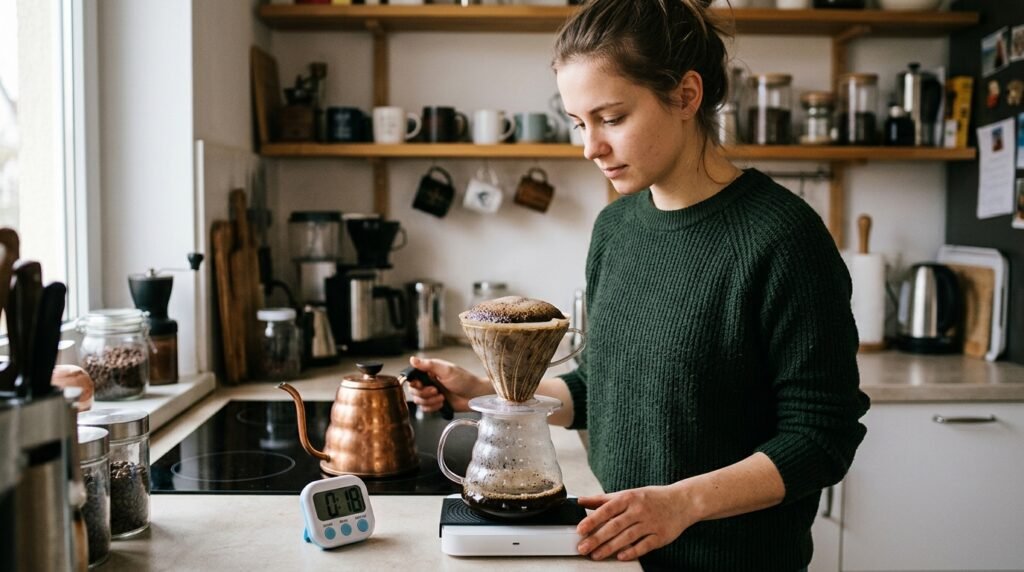
I poured forty grams of hot water gently over the dry coffee bed. I stopped pouring and set the heavy kettle down on the stove.
This is the bloom phase. Freshly roasted specialty coffee holds a massive amount of trapped carbon dioxide gas. When the hot water hits the grounds, this gas violently escapes. The coffee bed swells upward into a dark, bubbling dome.
You must wait forty five seconds for this gas to completely clear. If you rush this phase, the gas will repel the brewing water and ruin the extraction.
I stood in the quiet kitchen and watched the bubbles pop. I literally watched the seconds tick by on the digital timer. I was actively practicing the art of doing absolutely nothing. The coffee was forcing me to wait.
The Fluid Mechanics
The forty five seconds expired. I picked the heavy kettle back up.
I started the main concentric pour. This phase requires total physical control. If you pour the water too fast, you dig a deep crater in the coffee bed and ruin the extraction. You have to maintain a perfectly steady, slow, thin stream of water.
You have to move your wrist in tight, perfect circles. You have to watch the water level carefully. You have to monitor the numbers climbing steadily on the digital scale.
Your brain has absolutely no extra bandwidth to worry about digital problems. Recognizing this required focus was exactly The Morning I Realized Coffee Could Be a Ritual because the brewing process transformed from a mindless chore into a highly demanding physical meditation.
The End of the Pour
I watched the scale hit exactly two hundred and forty grams. I tilted my wrist back immediately. The water flow stopped.
I watched the final drops of dark red liquid fall from the plastic cone into my heavy ceramic mug. The extraction was mathematically and physically perfect. The coffee bed was flat and even.
I removed the plastic brewer and set it aside. I picked up a metal spoon and stirred the hot liquid three times to unify the chemical layers.
I picked up the hot ceramic mug. The routine in the kitchen was finished. But the most important part of the slow morning was just beginning.
The Living Room Transition
In my old life, I would carry the hot mug directly back into my home office. I would sit down at my desk and immediately begin consuming digital data.
I completely banned that behavior.
I carried the hot ceramic mug into my living room. The morning sunlight was just starting to hit the windows of my apartment. The city outside was beginning to move. My partner was sitting on the couch.
I sat down next to her. I placed the ceramic mug on the wooden coffee table.
The Thermal Delay
I did not drink the coffee.
Boiling hot water extracts the complex fruit sugars, but it also completely masks them on the human palate. If you drink coffee at one hundred and ninety degrees, you burn your tongue. You taste absolutely nothing but generic, dark bitterness.
You must let the thermal energy bleed out into the room. You have to wait for the liquid to drop to a comfortable one hundred and forty degrees. This takes at least five full minutes.
Once again, the coffee demands absolute patience. You cannot speed up the laws of thermodynamics.
The Analog Anchor
Sitting in silence for five minutes is incredibly difficult for a digital worker. The urge to grab my smartphone and check my email was massive. My brain was addicted to the dopamine of constant incoming information.
I needed a physical distraction. I needed an analog anchor.
I reached under the coffee table and pulled out my heavy paper sketchbook and a black ink pen. I am deeply fascinated by traditional Japanese Irezumi art. I love the complex geometry of the mythological creatures.
I opened the sketchbook to a blank page. I started drawing the sweeping, sharp curves of a Kitsune mask. I focused entirely on the black ink sinking into the thick white paper.
The Creative Reward
I drew slow, deliberate lines. I shaded the edges of the mask. I listened to my partner talk about her plans for the day.
I was using the mandatory cooling period to actually engage with my own creativity. I was not consuming trash digital content. I was creating something physical. The sketchbook absorbed my complete attention. My heart rate slowed down entirely. The stress of the upcoming workday completely evaporated.
Utilizing this quiet window of time was precisely The Coffee Habit That Improved My Daily Routine because it guaranteed I would practice my drawing every single morning. The coffee gave me the excuse to sit still.
The Sensory Payoff
After five minutes of sketching, I set the black pen down. I touched the outside of the ceramic mug. It felt perfectly warm, not dangerously hot.
I brought the cup to my lips. I took a slow, deliberate sip.
Because I had completely calmed my central nervous system, and because I had let the temperature drop, my palate was incredibly sensitive. The flavor resolution was absolutely staggering.
The Ethiopian coffee did not taste like muddy, generic bitterness. It tasted like a vibrant, heavy peach. The bright lemon acidity hit the front of my tongue cleanly. The finish tasted exactly like blooming jasmine flowers. The liquid was perfectly sweet and mathematically flawless.
The Armor for the Day
I drank the entire cup slowly. I finished my sketch of the Kitsune mask. I talked with my partner.
The entire routine took exactly twenty minutes from the moment I touched the hand grinder to the moment I swallowed the last sip of coffee.
When I finally stood up and walked into my home office, my mindset was completely different. I opened my laptop. The server alerts were there. The urgent client emails were there. But they did not trigger a panic response.
I had already accomplished something difficult. I had already built a perfect physical object. I had already drawn a beautiful piece of art. I was grounded, calm, and heavily caffeinated. The digital chaos could not penetrate the analog armor I had built in my kitchen.

Stop Sprinting
Look at your own morning routine tomorrow.
If you wake up and instantly surrender your brain to the internet, you are losing the psychological battle before the day even begins. If you are gulping terrible, automated coffee just to survive your commute, you are treating your body like a cheap machine.
You are allowed to move slowly. You are allowed to waste time on purpose.
Buy a manual grinder. Force yourself to crush the hard seeds by hand. Force yourself to wait for the bloom. Force yourself to let the liquid cool down. Grab a piece of paper and a pen. Draw a terrible picture. Read a physical book. Look out the window.
When you finally stop fighting the clock, you will realize that the ultimate value of specialty coffee is not the caffeine. The ultimate value is the mandatory, beautiful pause it inserts directly into your chaotic life. Slow down, respect the process, and finally taste the incredible sweetness hiding inside the roasted seed.
