
I remained in my chair on my balcony on a quiet Sunday morning. The intense heat of Rio de Janeiro had not fully arrived yet. I had a heavy paper sketchbook resting on my lap. I was studying the sharp, flowing lines of a traditional Japanese Kitsune mask. I was trying to replicate the deliberate geometry of the design with a black ink pen.
I set the pen down to take a break. I reached for my ceramic mug of coffee.
I had spent five minutes meticulously preparing the beverage. I used my heavy manual hand grinder. I used my precision digital scale. I executed a flawless pour over technique with my gooseneck kettle. I was brewing a highly complex Ethiopian Landrace coffee.
I brought the mug to my lips and took my first sip.
The liquid tasted incredibly weak. It tasted like hot water with a faint hint of sour lemon. I was instantly frustrated. I had followed my mathematical recipe perfectly. I assumed my expensive beans were stale. I assumed my grinder was broken.
I forced myself to keep drinking the terrible cup. When I finally reached the very bottom of the mug, the flavor profile suddenly changed violently. The last sip was incredibly thick, aggressively bitter, and overwhelmingly intense.
The coffee was not broken. The simple coffee habit that made a big difference fixed this exact sensory illusion. It required absolutely no new equipment. It only required a basic metal spoon. I learned that a perfect extraction is completely useless if you do not actively manage the liquid after the brewing process is finished.
The Illusion of the First Sip
For years, I judged the quality of my morning coffee based entirely on the very first sip.
I would watch the final drops of red liquid fall from my plastic V60 cone into my ceramic mug. I would immediately pick up the mug and drink. If that first contact with my palate tasted weak or sour, I would immediately begin planning how to change my variables for the next day. I would decide to grind finer. I would decide to increase my water temperature.
I was making massive mechanical adjustments based on completely fraudulent data.
I was completely ignoring the basic physics of fluid density. When you brew a manual pour over, the liquid entering your mug is not a single, homogeneous substance. It is a highly segmented, layered chemical stack.

The Three Phases of Extraction
To understand why the liquid is layered, you have to look at how hot water dissolves the roasted coffee seed.
Coffee extraction happens in three highly distinct phases. The hot water does not pull all the flavors out at the exact same time. The compounds dissolve at different speeds based on their molecular weight.
The very first drops of liquid that fall into your mug contain the highly soluble compounds. These are the bright fruit acids, the mineral salts, and the light organic fats. This initial liquid is incredibly dense. It is a thick, concentrated syrup. It tastes intensely sour and sharp.
The Sweet Middle
As the extraction continues into the second minute, the chemistry changes.
The hot water has already washed away the light acids. Now, it begins to penetrate deeper into the cellular walls of the coffee bean. It begins to dissolve the heavier Maillard compounds and the complex fruit sugars.
The liquid falling into your mug during this middle phase is no longer a thick syrup. It is lighter in color. It carries the heavy, sweet flavors of ripe peach, dark chocolate, and toasted nuts. This is the exact flavor profile you want to maximize.
The Bitter Finish
The third and final phase of the extraction happens at the very end of your pour.
The hot water has already extracted the acids and the sugars. The only compounds remaining inside the coffee grounds are the heavy, dry plant fibers and the harsh, bitter tannins.
The liquid falling into your mug during this final phase is incredibly pale. It is highly diluted. It contains almost no sweetness. It carries the astringent, bitter flavors that dry your tongue out. You need a very small amount of this bitter liquid to provide structural balance to the cup, but you must stop the pour before it overwhelms the beverage.
The Stacked Cake of Coffee
Now look at the physical reality inside your ceramic mug.
The heavy, sour syrup fell in first. It sank directly to the very bottom of the cup. The sweet, sugary liquid fell in next. It formed a layer right on top of the syrup. The weak, watery, bitter liquid fell in last. It sits entirely on the surface.
Your coffee is stacked exactly like a three layer cake.
When I picked up my mug and took my first sip, I was only drinking the top layer. I was drinking the weak, bitter water from the final phase of the extraction. I was not tasting the heavy sweetness or the bright acidity. They were hiding at the bottom of the cup.
Understanding this uneven distribution was exactly The Simple Coffee Mistake I Made Every Morning for Years because I constantly blamed my expensive equipment instead of my own final steps. I was acting like a scientist during the brewing phase and a complete amateur during the tasting phase.
The Intervention of the Spoon
The solution to this massive sensory problem is incredibly basic. You must destroy the layers.
When the extraction finishes, you cannot just pick up the mug and drink. You must grab a clean metal spoon. You must lower the spoon to the very bottom of the ceramic mug and stir the liquid aggressively.
I stir my coffee exactly three times in a wide, circular motion.
This simple mechanical action forces the heavy syrup at the bottom to mix violently with the watery layer at the top. It blends the bright fruit acids, the heavy sugars, and the light tannins into a single, cohesive beverage. The stratification is entirely erased.
The Transformation of the Flavor
The next morning, I tested this new mechanical habit.
I brewed my Ethiopian coffee perfectly. I watched the final drops fall. I removed the plastic cone. I grabbed a metal spoon and stirred the dark red liquid three times.
I waited a few minutes for the extreme heat to bleed out into the room. I took my first sip.
The transformation was absolute. The weak, watery flavor was completely gone. The aggressive, sour notes were perfectly tamed. The liquid tasted incredibly unified. The bright lemon acidity hit my tongue at the exact same time as the heavy peach sweetness. The flavor was highly articulate and perfectly round.
Unlocking this uniform sweetness was the core of How I Started Noticing Flavor Notes in Coffee because my palate could finally recognize the full profile of the bean at once. The flavor was no longer fragmented into confusing layers.
The Visual Proof of the Carafe
If you do not believe that coffee naturally stratifies, you can prove it to yourself visually.
You just need to stop brewing directly into an opaque ceramic mug. Buy a clear glass coffee server. Brew your daily pour over into the transparent glass vessel. Do not stir it.
Hold the glass up to the light of your kitchen window.
You will clearly see the physical separation. The liquid at the very bottom of the glass will be dark, thick, and almost black. The liquid at the very top of the glass will be highly transparent and pale red. The visual evidence of fluid density is undeniable.
This is exactly why professional baristas serve pour over coffee in small glass carafes. They swirl the carafe aggressively before they pour the liquid into your cup. The swirling action performs the exact same chemical homogenization as the metal spoon.
The Secondary Habit
Once I realized the massive impact of stirring the final brew, I introduced a second, complimentary habit to my morning routine.
I realized I was treating my own palate just as poorly as I was treating the coffee layers. I would wake up, brush my teeth, and immediately try to drink delicate specialty coffee. The mint toothpaste completely destroyed my sensory receptors.
Even if I did not brush my teeth, my mouth was dry from sleeping. A dry palate cannot detect complex fruit sugars.
I needed to prepare the tasting environment.
The Required Palate Cleanser
I started keeping a large glass of cold, filtered water directly next to my coffee station.
Before I ever touch the ceramic mug, I drink the entire glass of cold water. This simple physical action is incredibly important. It completely washes away the stale flavors of the morning. It removes residual toothpaste. It removes the flavor of breakfast food.
More importantly, it completely hydrates the cellular receptors on my tongue.
When your tongue is fully hydrated, it becomes highly sensitive to delicate organic acids. The cold water acts as a massive reset button for your brain. It provides a completely blank sensory canvas for the coffee to paint on.
The Patience of the Cool Down
The third and final piece of this new morning habit involves strict patience.
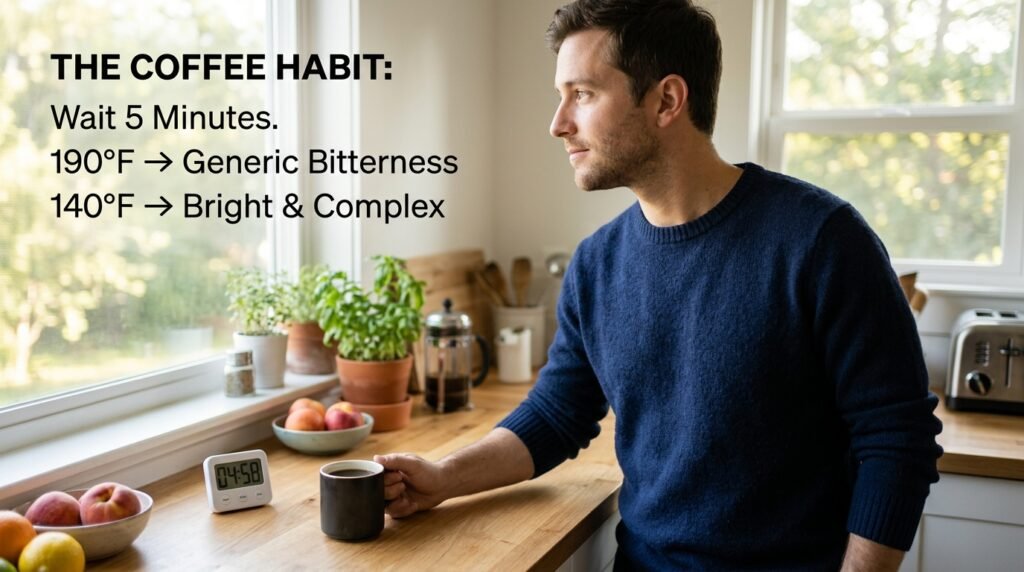
After I stir the coffee, and after I drink my glass of cold water, I simply walk away. I do not drink the hot coffee immediately. I take my ceramic mug and place it on my desk. I look at my digital servers. I look at my Japanese art books. I let five minutes pass completely.
Hot water masks flavor. The human tongue is terrible at perceiving complex sugars when it is being burned.
If you drink coffee at one hundred and ninety degrees, it will taste like hot, generic bitterness. If you wait for the coffee to drop to one hundred and forty degrees, the heat blanket is lifted. The peach notes, the floral aromas, and the bright citrus acids become aggressively obvious.
Making this tiny mechanical adjustment became The Coffee Habit That Improved My Daily Routine because it guaranteed consistency in the mug. I stopped feeling anxious about my extraction parameters. I knew the flavor was accurately represented.
The Complete Sensory Workflow
My morning workflow is now completely locked in. It is a strict sequence of events designed to protect the agricultural product from start to finish.
I weigh the beans. I grind them uniformly. I control the water temperature. I execute the concentric pour.
Then, the critical final phase begins. I remove the brewer. I stir the liquid violently with a metal spoon to unify the chemical layers. I drink a large glass of cold water to sanitize my palate. I wait five minutes for the thermal energy to dissipate.
Only then do I take my first sip.
The Elimination of Waste
This strict sensory protocol completely eliminates financial waste in my kitchen.
Before I adopted these habits, I would frequently throw expensive coffee beans in the trash. I would brew a cup, taste the watery top layer, assume the beans were terrible, and discard the entire bag. I was throwing away perfect coffee simply because I failed to mix the fluid dynamics.
Now, every single bag of coffee I purchase yields incredible results. I extract the maximum value out of every single gram of the roasted seed.

Fix Your Final Step
Look closely at your own morning routine tomorrow.
You might own the most expensive manual burr grinder on the market. You might use laboratory grade customized water. You might execute a flawless, timed extraction.
But if you watch the final drop fall, pick up your mug, and take an immediate sip, you are actively sabotaging your entire physical effort. You are judging a symphony by listening to only one instrument.
Do not trust the top layer of your coffee. It is a watery, bitter lie.
Grab a clean spoon. Stir the dark liquid aggressively. Unify the bright acids, the heavy sugars, and the complex tannins. Wash your palate with cold water. When you finally take a slow sip of a perfectly homogenized, properly cooled extraction, you will taste the absolute depth of the farm. You will stop drinking fragmented layers, and you will finally experience the true harmony of the roasted seed.
