
The coffee setup I use every day at home fits entirely on a single twelve inch square of my kitchen counter. It is a strictly analog workstation built for absolute precision and zero waste. There are no massive plastic appliances. There are no flashing digital clocks. I manage digital workflows and web servers for a living. I stare at complex software all day. When I wake up in my apartment in Rio de Janeiro, I want my kitchen to be a quiet, tactile sanctuary.
I deliberately designed my morning station to function like a professional laboratory.
Every single tool has a highly specific mechanical purpose. If a piece of equipment does not actively improve the chemical extraction of the roasted seed, I remove it from the counter. I do not care about visual trends or expensive aesthetic props. I care exclusively about the raw data and the final flavor profile.
Building this physical workstation was exactly How I Found the Perfect Coffee Routine for Myself because I stopped trying to copy massive commercial cafes. I built a system specifically tailored for one person operating at six o’clock in the morning. This is the exact hardware and software I use to brew my daily cup.
The Software Storage
The foundation of my entire setup is the raw agricultural material. I consider the roasted coffee beans to be the software.
I drink light roasted African coffees. I am constantly searching for Ethiopian Landrace varieties. These ancient, wild genetics produce incredibly fragile floral notes and bright peach acidity. They are highly susceptible to oxidation.
I refuse to leave these expensive beans in a crumpled paper bag.
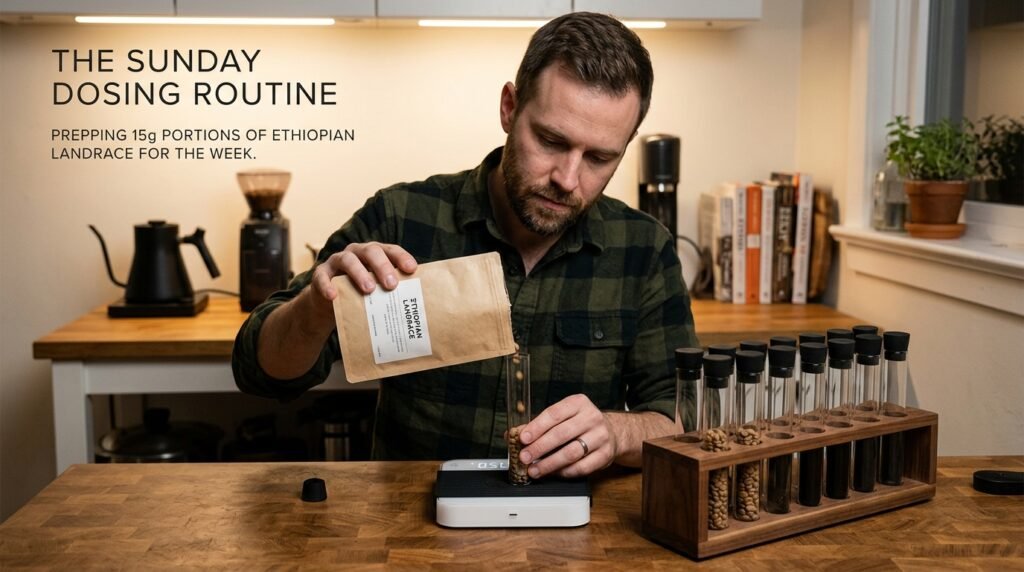
My counter features a small wooden block holding twelve thick glass test tubes. I use these tubes to batch process my coffee. Every Sunday night, I weigh exactly fifteen grams of the Ethiopian beans into each glass cylinder. I seal them with heavy silicone caps. This traps the carbon dioxide and blocks the corrosive oxygen completely. My week is prepped and perfectly portioned.
The Data Center
Directly next to the wooden block sits a flat, black digital kitchen scale. This is my data center.
I cannot execute a successful chemical extraction if I do not know the exact mass of my ingredients. Volume is a liar. I never use plastic scoops to measure my beans. I never estimate the water level in my mug.
The digital scale tracks physical weight down to a tenth of a gram. It provides the strict mathematical boundaries for my recipe. I use a one to sixteen brew ratio. Fifteen grams of coffee requires exactly two hundred and forty grams of water. The scale ensures I hit those exact numbers every single day.
The Static Elimination
Before the coffee beans can be processed, I have to manage the physical environment.
Rio de Janeiro is humid, but grinding dense coffee beans still generates a massive amount of static electricity. If I grind dry beans, the microscopic coffee dust flies into the air and coats my clean counter.
Sitting right beside my scale is a tiny glass spray bottle. It costs two dollars. I fill it with filtered drinking water.
I uncap a glass tube of beans. I spray one single, microscopic mist of water directly into the tube. I shake it for two seconds. This tiny drop of moisture instantly grounds the static charge. It is a cheap, brilliant mechanical hack that keeps my workstation completely spotless.
The Processing Engine
The true heart of my coffee setup is the grinder. It is the most expensive and most important tool I own.
I do not use an electric grinder. I use a heavy, industrial manual hand grinder. It is machined from solid stainless steel and matte aluminum. It houses incredibly sharp, precision ceramic burrs.
I pour the damp coffee beans into the top chamber and attach the metal handle. I brace my feet on the floor and physically crush the seeds. Light roasted Ethiopian coffee is rock hard. It takes genuine physical effort to force the burrs through the dense material.
Committing to this physical labor was The Coffee Routine That Helped Me Slow Down and provided a necessary break from my digital screens. The grinder produces flawless, uniform particles without waking my partner up with a screaming electric motor.
The Microscopic Fluffer
Once the coffee is ground, it drops into a small metal catch bin. I pour the uniform grounds into my paper filter.
Even with a perfect grinder, the coffee particles naturally settle and form small clumps. If I pour water over clumped coffee, the water will channel. It will drill holes through the weak spots and leave the clumps completely dry.
To fix this, I keep a WDT tool on my counter. It stands for Weiss Distribution Technique.
It is a small aluminum handle holding six incredibly thin acupuncture needles. I lower the needles into the dry coffee bed and stir gently for five seconds. The needles slice through the clumps effortlessly. They fluff the coffee into a light, airy bed of sand. The preparation is now perfectly uniform.
The Thermal Control
Water makes up nearly ninety nine percent of the final beverage. The delivery of that water is critical.
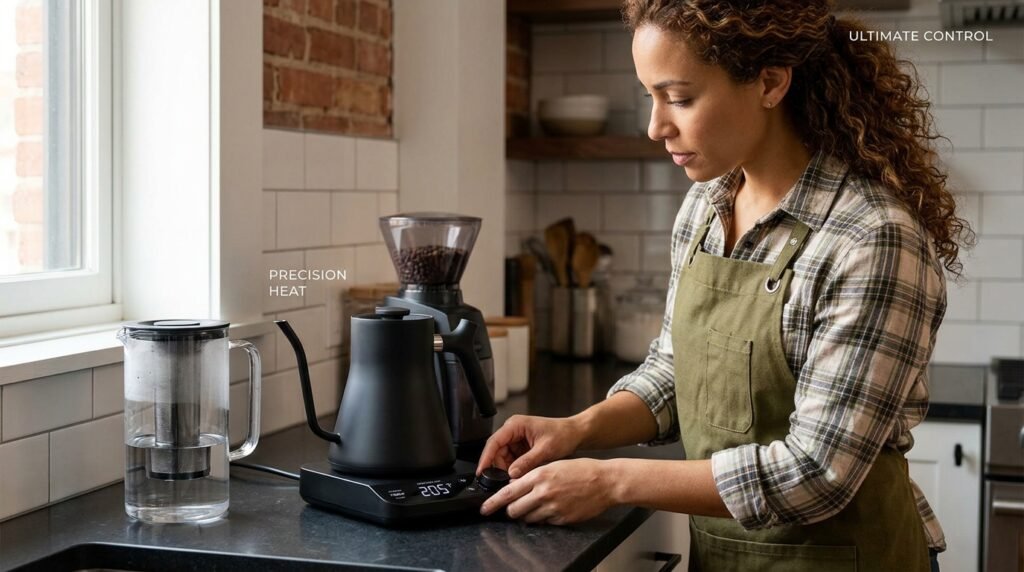
I use a variable temperature electric gooseneck kettle. It sits on a digital base station right next to my grinder. This kettle gives me absolute authority over the thermal dynamics of my kitchen.
I fill the kettle with water that has been processed through a carbon filter pitcher. I never use harsh tap water. I set the digital dial on the base to exactly two hundred and five degrees Fahrenheit.
The heavy copper heating element brings the water to the target temperature in three minutes. The machine then holds that exact heat indefinitely. I do not have to stare at a thermometer. I do not have to wait for a stove to boil.
The Fluid Dynamics
The electric base provides the heat, but the kettle itself provides the physical control.
The kettle features a long, sweeping gooseneck spout. The opening at the tip is incredibly narrow. This specific geometry forces the boiling water to align into a perfect, glassy rod of laminar flow.
When I hold the counterbalanced handle, my wrist is perfectly stable. I can direct a tiny, gentle stream of hot water exactly where I want it. I can paint the surface of the coffee bed without digging deep, destructive craters into the delicate grounds. The fluid dynamics are entirely within my control.
The Passive Brewer
The focal point of the extraction happens inside the brewer.
Many people spend hundreds of dollars on beautiful glass carafes with leather straps. I use a dark plastic V60 cone. It costs ten dollars.
A manual brewer is a completely passive object. It does not do any work. It simply holds the paper filter. I prefer plastic because it is an incredible thermal insulator. It traps the heat inside the coffee slurry instead of bleeding it out into the room like glass or ceramic. It is also completely indestructible.
I place an oxygen bleached white paper filter inside the plastic cone. I rinse the paper heavily with boiling water to wash away any residual cardboard flavor.
The Backup System
The plastic V60 is my primary daily driver. It produces the absolute highest level of flavor clarity. But it requires three minutes of undivided attention to pour the water correctly.
Sometimes, my professional workload is chaotic. I need a massive hit of caffeine, but I cannot stand still.
For those busy mornings, an AeroPress sits on the back corner of the counter. It is a thick polycarbonate cylinder that uses immersion brewing. I dump the grounds and the water inside, stir, and walk away to answer emails. Two minutes later, I push the plastic plunger down. It delivers a heavy, rich, flawless cup of coffee with almost zero manual pouring technique required.
The Physical Ledger
The final piece of equipment on my counter does not touch the coffee at all. It is a small, black paper notebook and a smooth ink pen.
I treat coffee brewing like a scientific experiment. I have to document the variables.
Every single morning, I write down the exact dose of coffee, the exact water temperature, the exact click setting on my hand grinder, and the total drawdown time.
Tracking these numbers daily was The Simple Coffee Change That Made Every Cup Better because it completely eliminated the morning guessing game. If the coffee tastes perfectly sweet and floral today, I have the exact mathematical recipe safely recorded in ink. I can replicate the success flawlessly tomorrow.
Executing the Morning Flow
The beauty of this minimal setup is the smooth execution of the workflow.
When my alarm goes off, I walk into the quiet kitchen. I press the button on the electric kettle. I grab a glass tube of Ethiopian beans. I spray the tiny drop of water. I dump the beans into the grinder.
I turn the heavy metal crank. The room smells like explosive peach and jasmine. I pour the grounds into the rinsed paper filter. I fluff the bed with the thin needles.
The kettle beeps. The water is ready.
The Concentric Pour
I place the plastic V60 and my heavy ceramic mug onto the digital scale. I zero the numbers.
I pour forty grams of water to initiate the bloom. The fresh coffee swells into a beautiful, dark dome. The carbon dioxide escapes smoothly.
I resume pouring in slow, tight concentric circles. I watch the red liquid drain. I watch the digital numbers climb on the scale. The process requires exactly the same deliberate, focused physical control as drawing the crisp lines of a traditional Japanese tattoo. A single careless movement ruins the integrity of the design.
The extraction finishes. The spent coffee grounds form a perfectly flat, clean bed at the bottom of the filter.
The Final Result
I carry the ceramic mug to my computer desk. The digital world is waiting for me.
I take a slow sip of the coffee. The flavor is absolutely pristine. The bright, juicy acidity of the African dirt hits my palate. The heavy floral sweetness coats my tongue. There is absolutely zero harsh bitterness. There is zero muddy texture.
The coffee tastes like an expensive culinary ingredient because I treated it like one.
I did not run the delicate seeds through a chaotic plastic machine. I processed them through a strict, highly controlled analog system.

The Philosophy of the Counter
Your kitchen counter is a direct reflection of your culinary priorities.
If your counter is covered in massive automated machines, cheap plastic blenders, and messy bags of old coffee, you are prioritizing false convenience. You are accepting a chaotic, bitter extraction.
You can build a professional workstation for a fraction of the cost of a luxury espresso machine.
Clear the clutter. Buy a premium hand grinder. Buy a digital scale. Buy a variable temperature gooseneck kettle. Invest in the tools that actually manipulate the chemistry of the water. When you strip the process down to its raw physical mechanics, your morning stops being a frustrating chore. It becomes a calm, reliable system that delivers absolute perfection in the mug.
