
I was sitting at my desk in Rio de Janeiro late on a Tuesday night. I was auditing a large database for a client website. I needed to finish the project before midnight. My eyes were heavy. I needed a strong cup of coffee to push through the final hours of work.
I walked into my kitchen and opened my cabinet. I grabbed a paper bag of specialty coffee.
I had purchased this bag just five days earlier from a local independent roaster. It was a beautiful, light roasted Ethiopian Guji. Because I did not own a grinder at the time, I asked the barista to grind the entire bag for me at the shop. I watched him pour the whole beans into his massive commercial machine. I took the bag of ground coffee home and placed it on my shelf.
I opened the bag on that Tuesday night and expected to smell sweet jasmine flowers. I leaned in and took a deep breath.
The smell was completely gone. The bag smelled like dry cardboard and stale peanuts. I brewed a cup anyway, hoping the flavor would somehow survive the hot water. I took a sip. The coffee tasted entirely flat, lifeless, and boring. The beautiful fruit notes had vanished completely. This massive disappointment was the exact catalyst for my hardware upgrade. Why I finally decided to buy a coffee grinder was not about being a snob. It was about protecting my financial investment and stopping the rapid biological decay of my morning beverage.
The Illusion of Convenience
For a very long time, I prioritized speed over everything else in my kitchen.
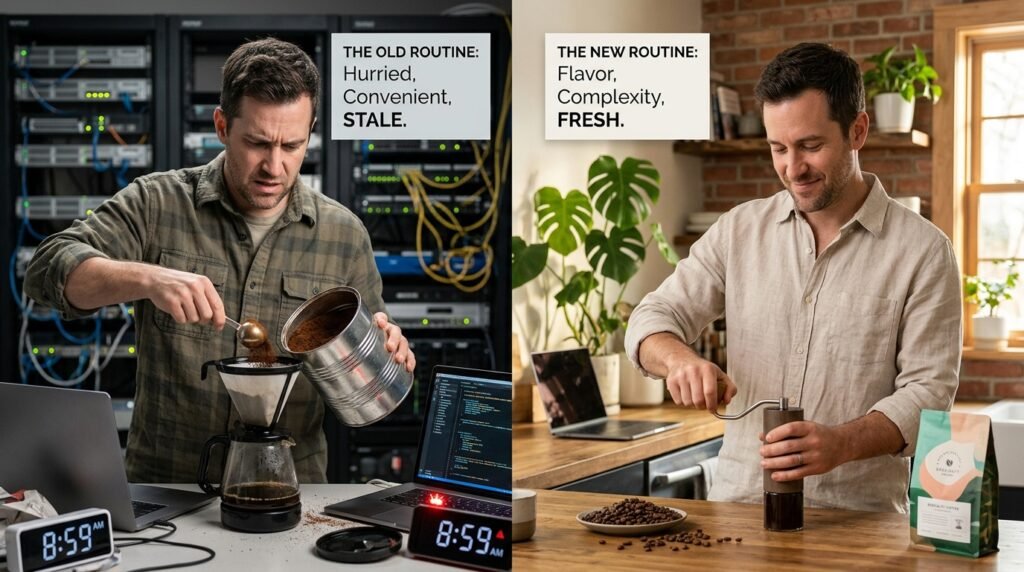
I manage multiple websites and deal with urgent server issues daily. I convinced myself that I did not have the time to grind my own coffee every morning. I thought buying pre ground coffee was a smart life hack. I could just scoop the grounds into my filter, pour the water, and get back to my computer screen in two minutes.
I traded the absolute quality of the raw ingredient for a minor convenience.
This decision was a massive culinary failure. Realizing this error was the foundation of What Happened When I Stopped Buying Pre-Ground Coffee and it forced me to completely rewrite my morning routine. I realized I was actively ruining the product before I even boiled my water.
The Cellular Vault
To understand why pre ground coffee goes bad so quickly, you have to look at the anatomy of the roasted seed.
A whole coffee bean acts exactly like a biological vault. During the intense heat of the roasting process, massive amounts of volatile aromatic compounds and delicate oils are created. These chemical compounds provide the flavors of bright peach, sweet strawberry, and dark chocolate.
As long as the coffee bean remains whole, those delicate compounds stay locked safely inside the hard cellular structure. The tough outer shell of the seed protects the internal oils from the outside environment.
A whole roasted coffee bean can stay relatively fresh for three or four weeks if stored properly in a dark cabinet. The vault remains sealed.
Shattering the Vault
When you drop a coffee bean into a grinder, you completely destroy the vault.
You take a single, solid object and shatter it into hundreds of microscopic pieces. By breaking the bean apart, you drastically increase the total surface area of the coffee. You forcefully expose all the hidden organic lipids and volatile compounds to the open air.
This exposure triggers an immediate and violent chemical reaction.
The moment the coffee is ground, the delicate floral and fruit aromas evaporate into the atmosphere. You can actually smell this happening. The massive burst of aroma that hits your nose when you grind fresh coffee is the sound of the vault emptying. Those aromatic compounds are leaving the seed and entering the air.
The Enemy Called Oxidation
Evaporation is only the first problem. The second problem is oxygen.
Oxygen is highly corrosive to organic matter. When the microscopic coffee particles are exposed to the air, the oxygen immediately begins attacking the natural oils. It breaks down the complex sugars. It degrades the delicate organic acids.
This chemical degradation is called oxidation. It is the exact same process that turns a sliced apple brown when you leave it sitting on your kitchen counter.
When you grind a bag of coffee at the store and take it home, you are exposing the entire batch to massive amounts of oxygen simultaneously. The biological clock accelerates violently.
The Speed of the Decay
The timeline of ground coffee is incredibly fast.
A whole bean takes weeks to go stale. Ground coffee goes noticeably stale in about fifteen minutes. Within twenty four hours, the majority of the complex fruit notes are completely dead. Within five days, the coffee is chemically flat.
Understanding this strict timeline was exactly The Day I Finally Understood Why Fresh Coffee Beans Matter and it completely changed my buying habits. I realized I was paying a premium price for specialty coffee, but I was drinking the flavor of stale supermarket dust.
When I asked the barista to grind my expensive Ethiopian beans on Friday afternoon, the coffee was already dying by the time I walked back to my apartment.
The Financial Waste
Sitting at my desk with that terrible, cardboard flavored coffee on Tuesday night, the financial reality hit me hard.
I was spending twenty dollars on a bag of single origin coffee. The farmer in Africa spent months cultivating the crop. The roaster carefully developed the sugars. I paid for that intense labor.
By having the bag ground at the shop, I was literally throwing the value in the trash. I was paying twenty dollars for a product that tasted like cheap diner coffee four days later. I was wasting my own money simply because I was too lazy to turn a metal handle for forty five seconds a day.
Researching the Hardware
I poured the stale coffee down the kitchen sink. I opened my laptop. I decided to fix the problem immediately.
I started researching coffee grinders. I quickly learned that I could not just buy a cheap appliance from the local supermarket.
Most cheap grinders use spinning metal blades. They act like miniature blenders. They chop the beans violently and randomly. This creates a chaotic mixture of massive coffee boulders and microscopic powdery dust. A blade grinder destroys the uniformity of the coffee and guarantees a bitter, muddy extraction.
I needed a tool that provided absolute precision. I needed a burr grinder.
The Manual Solution
Premium electric burr grinders are incredibly expensive. They cost hundreds of dollars. I did not want to spend that much money on my first piece of real equipment.
I found a perfect compromise. I ordered a heavy duty, manual hand grinder.
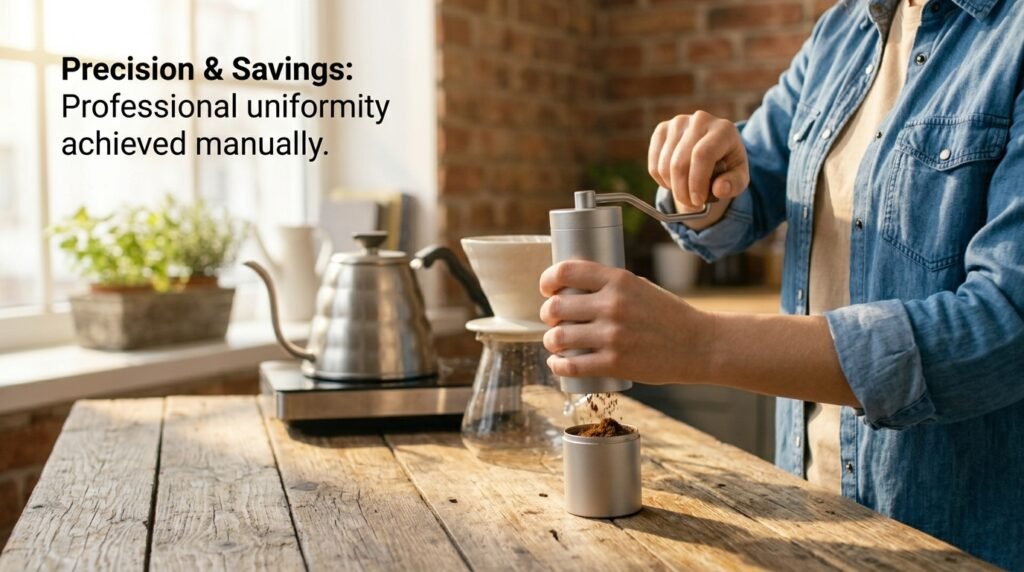
It was built from solid stainless steel and aluminum. It featured sharp, precision ceramic burrs. Because it did not have an electric motor, the entire cost of the tool went directly into the quality of the grinding mechanism. It offered professional level uniformity at a fraction of the price.
The Arrival of the Tool
The heavy metal cylinder arrived at my apartment a few days later. I was ready to test the theory of freshness.
I walked to the local roastery. I bought a brand new bag of light roasted Ethiopian Guji. This time, I firmly told the barista I wanted whole beans. I carried the sealed bag home.
I set up my digital scale on the kitchen counter. I weighed exactly fifteen grams of the solid brown seeds. I poured them into the top chamber of my new manual grinder. I attached the metal handle and gripped the cylinder tightly.
The Physical Connection
I started turning the crank. The physical resistance was intense.
Light roasted African coffees are incredibly dense. The seeds are rock hard. I had to brace my feet on the floor and use genuine physical strength to force the ceramic burrs through the coffee.
I actually enjoyed the effort. My daily work involves clicking a mouse and typing on a keyboard. Grinding the coffee forced me to interact with the physical world. It forced me to slow down and respect the raw material. I felt directly connected to the agricultural product in my hands.
The Aromatic Explosion
I finished grinding the dense beans. I unscrewed the metal catch bin at the bottom of the cylinder.
The sensory experience was absolutely shocking. A massive, heavy cloud of volatile aromatics filled my kitchen instantly. It smelled intensely of ripe peaches, sweet strawberry jam, and blooming jasmine flowers.
The smell was so vibrant and powerful that it actually caught me off guard. This was the exact aroma I had been missing for years. By breaking the cellular vault open exactly ten seconds before I poured the water, I captured every single volatile compound before it could evaporate.
The Visual Proof
I poured the fresh grounds into my glass V60 pour over cone. I boiled my gooseneck kettle.
I poured forty grams of hot water to start the bloom phase. The visual reaction was spectacular. The coffee bed violently erupted. Massive bubbles formed and popped across the surface. The dark slurry swelled into a large dome.
This visual chaos was the physical proof of freshness.
When coffee is roasted, it traps massive amounts of carbon dioxide gas. When coffee is ground and left in a bag, that gas escapes slowly over a few hours. Because I ground the beans fresh, the gas was still trapped inside the particles. The hot water forced the gas to violently expand and escape.
Witnessing this aggressive bloom confirmed exactly How I Learned Coffee Storage Affects Flavor because a flat, lifeless bloom means the coffee is completely oxidized. My coffee was completely alive.
The Return of the Fruit
I finished pouring the rest of the water. I waited for the ruby red liquid to drain through the paper filter.
I carried my ceramic mug to my desk. I waited three minutes for the temperature to drop. I took a slow sip.
The flavor transformation was absolute. The stale, dusty cardboard taste was entirely gone. A brilliant, sharp wave of lemon acidity hit my palate. It tasted incredibly clean. That bright citrus note melted seamlessly into a heavy, syrupy peach sweetness. The lingering aftertaste was perfectly floral.
I finally tasted the coffee exactly how the roaster intended. I finally got what I paid for.
The Daily Protection
Owning a burr grinder completely changes the economics of your kitchen.
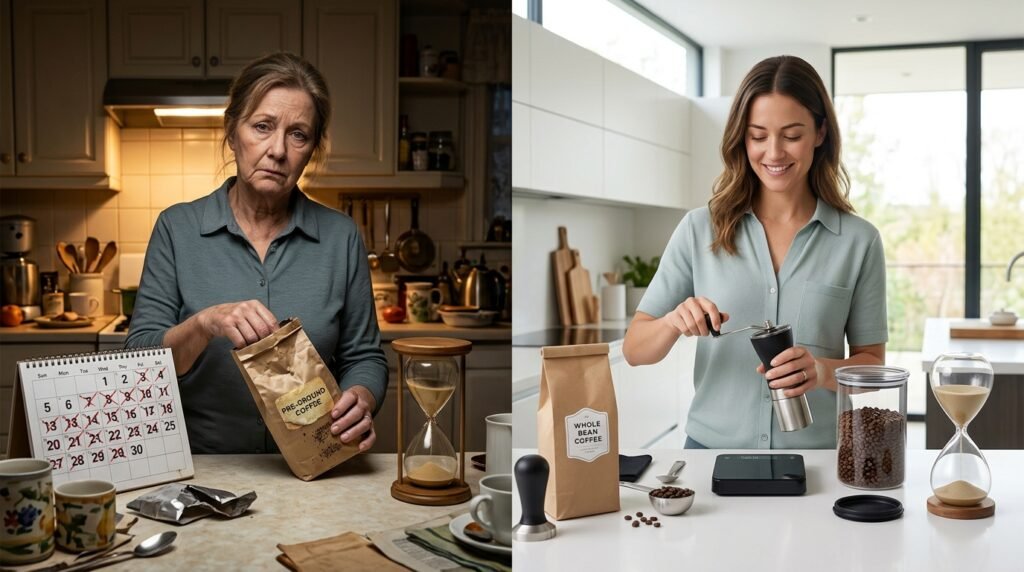
When you keep your coffee beans whole, the bag degrades very slowly. The cup of coffee you brew on Monday morning will taste almost exactly the same as the cup you brew on the following Sunday. The cellular vault protects your investment.
You are no longer racing against a rapid biological clock. You can open a bag of coffee and enjoy it at a relaxed, comfortable pace. You do not have to drink flat, stale water simply because the calendar moved forward three days.
Stop Wasting Your Money
If you are currently buying premium specialty coffee from a local roaster, and you are asking them to grind it for you, you must stop immediately.
You are throwing your hard earned money directly into the garbage. You are paying for a brilliant agricultural product, but you are drinking the oxidized, stale ghost of that product. The convenience of speed is not worth the total destruction of flavor.
You need to buy a burr grinder.
Do not buy a cheap blade blender. Buy a heavy, precision manual hand grinder. It requires a minor amount of physical labor every morning, but that labor unlocks the absolute clarity of the coffee bean. When you finally smell the explosive aroma of a freshly shattered seed, and you taste the vibrant fruit notes in your mug, you will completely understand why the grinder is the most critical tool in your entire kitchen.
