
I spend my entire week living in a digital world. I sit in my home office in Rio de Janeiro and stare at a glowing monitor. I build automated workflows. I optimize website structures. I manage large databases of content.
My work is completely invisible. I cannot physically touch a line of code. I cannot hold a website in my hands.
By the time Friday morning arrives, my brain is usually desperate for physical feedback. I need to interact with the analog world. I need to touch something real.
I walk away from my computer and step into my kitchen. I grab a heavy ceramic mug and a glass pour over cone. I reach into my cabinet and pull out a bag of freshly roasted Ethiopian coffee.
Most people talk about fresh coffee strictly in terms of flavor. They talk about the bright acidity or the sweet chocolate notes. But flavor is only half of the experience. Why freshly roasted coffee feels different is an entirely physical phenomenon. A fresh coffee bean is a dynamic, living object. It interacts with your hands, your equipment, and your palate in a way that stale supermarket coffee simply cannot replicate.
The Illusion of the Dry Seed
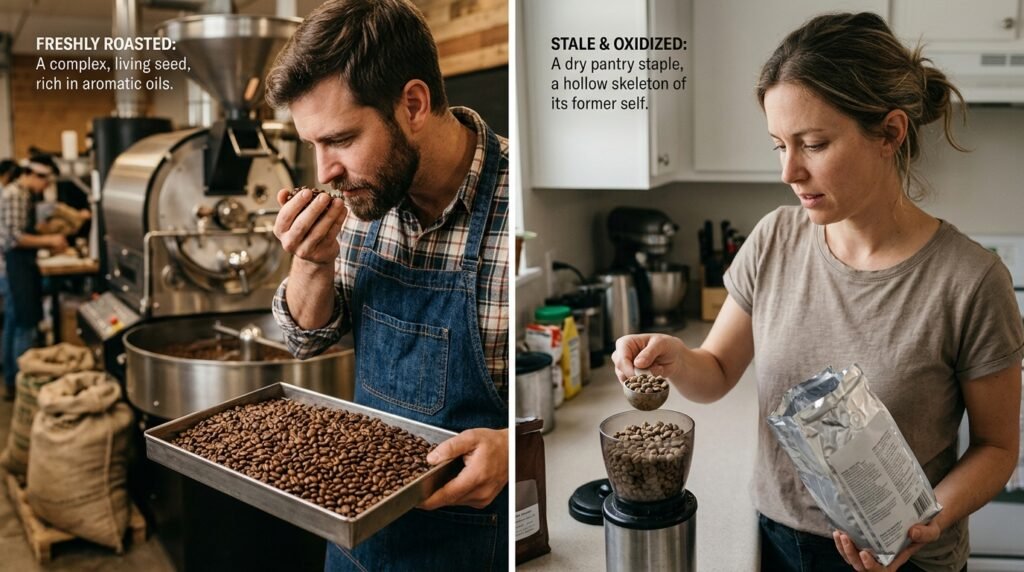
We are conditioned to think of coffee as a dry, dead pantry staple. We group it together with dry pasta, white rice, and table salt.
This is a fundamental misunderstanding of the ingredient.
A coffee bean is not a rock. It is the roasted seed of a tropical fruit. It is an incredibly complex matrix of organic chemistry. Inside that small brown seed, there are delicate lipids, heavy oils, and volatile aromatic compounds.
When coffee is fresh out of the roasting drum, all of those organic materials are completely intact. The seed is physically heavy. It is dense. It holds structural integrity.
When coffee sits in a warehouse for six months, it undergoes severe oxidation. The oxygen in the air attacks the cellular walls. It dries out the internal oils. It degrades the lipids. The seed literally turns into a dusty, hollow skeleton of its former self.
The Weight in the Hand
You can physically feel this difference before you ever start brewing.
I opened my new bag of Ethiopian beans. The roast date on the back of the package was exactly five days ago. I poured a small handful of the pale brown seeds into my palm.
They felt incredibly dense. They felt like small, heavy river stones. If you drop a fresh coffee bean on a hard wooden counter, it makes a sharp, solid sound.
I kept an old, stale bag of commercial coffee in my pantry for comparison. I poured a handful of those old beans into my other hand. The contrast was shocking. The old beans felt incredibly light. They felt like dry pieces of styrofoam. The moisture and the heavy oils had completely evaporated months ago.
The Mechanical Resistance
The physical nature of the fresh seed completely changes how your equipment behaves.
I use a manual hand grinder every morning. I refuse to use an electric grinder because I want to feel the physical process of breaking the beans.
I poured twenty grams of the fresh Ethiopian seeds into the hopper. I grabbed the metal handle and started turning. The physical resistance was massive. The dense, lipid rich seeds fought back against the ceramic burrs. The handle jerked in my hand. I had to brace my feet on the floor and use genuine physical strength to force the burrs to spin.
Paying attention to this mechanical feedback was a core part of The Morning I Realized Coffee Could Be a Ritual and it permanently changed how I interact with the beverage. I was not just pushing a button. I was actively participating in a physical transformation.
The Texture of the Grounds
The physical differences continue after the beans are shattered.
I unscrewed the catch bin of my hand grinder. I looked at the fresh coffee grounds. They did not look like dry sand. They looked heavy and slightly clumped together.
Because the coffee was only five days old, the natural oils were still incredibly vibrant. When the ceramic burrs crushed the cellular walls, those oils were released. The oils caused the small coffee particles to stick to each other. The grounds felt soft and slightly damp to the touch.
If you grind a stale bag of supermarket coffee, the result is entirely different. The grounds look like dry, dusty sawdust. They produce a massive amount of static electricity because they lack any natural moisture or lipid content. They fly everywhere and stick to the sides of the plastic bin.
The Violence of the Gas
I poured the fresh, heavy grounds into my glass V60 cone. I boiled my gooseneck kettle.
This is the exact moment where the physical nature of fresh coffee becomes visually explosive.
During the intense heat of the roasting process, the coffee bean traps massive amounts of carbon dioxide gas inside its tight cellular walls. When the coffee is fresh, it is physically bloated with this gas.
I poured forty grams of hot water over the dry grounds to begin the bloom phase. The hot water acted as a massive thermal catalyst.
The coffee bed violently erupted. The hot water forced the trapped carbon dioxide to rapidly expand and push its way out of the broken cells. The grounds swelled upward, creating a massive, dark dome. Thick bubbles formed and forcefully popped on the surface.
The Resistance of the Water
The escaping gas does not just look impressive. It physically alters the flow of the water.
The carbon dioxide acts as a microscopic shield. It actively pushes back against the water dripping from the kettle. It creates massive turbulence inside the paper filter.
Because the gas is fighting the water, the water drains much slower. The fresh coffee bed provides heavy physical resistance. You have to pour your water slowly and carefully to maintain control.
If you pour hot water over stale coffee, nothing happens. The gas evaporated months ago. The coffee bed stays completely flat. The water rushes straight through the dry, dead particles with zero resistance. The resulting liquid is weak and under extracted.
Realizing this physical decay was the exact premise of How I Discovered Coffee Freshness Matters More Than I Thought because I noticed my drawdown times changing drastically as the bag aged. The physical behavior of the slurry is a direct indicator of the biological age of the seed.

The Weight of the Liquid
I finished pouring the water. I let the bright ruby liquid drain into my ceramic mug. I removed the glass cone and sat at my kitchen table.
We often describe drinks as being heavy or light. We say whole milk is heavy and skim milk is light. We are describing the physical viscosity of the fluid.
Coffee has viscosity.
I took a slow sip of the fresh Ethiopian brew. The flavor was spectacular, but the physical sensation on my tongue was even more impressive. The liquid felt thick. It coated my entire palate. It felt like a thin syrup.
This heavy mouthfeel is a direct result of the fresh lipids and oils. The hot water dissolved those intact organic compounds and carried them through the paper filter into the mug. Those compounds physically thicken the water.
The Absence of the Void
Stale coffee lacks this physical weight entirely.
When the oxygen degrades the lipids in an old bag of coffee, those compounds vanish. They cannot be extracted into the mug because they no longer exist inside the seed.
If you brew a cup of stale commercial coffee, the liquid feels incredibly thin. It feels sharp and watery. It disappears from your tongue immediately after you swallow. There is a massive physical void in the center of the beverage.
Fresh coffee lingers. The heavy oils coat your throat. The physical sensation remains in your mouth for several minutes. It feels like a substantial culinary ingredient, not just a colored glass of hot water.
The Evolution in the Mug
Fresh coffee is also a highly dynamic physical object. It refuses to remain static.
I kept my ceramic mug on the table and continued to take small sips over the next twenty minutes. I watched the temperature slowly drop.
As the coffee cooled down, the physical texture of the liquid actually changed. The human tongue is highly sensitive to temperature. Extreme heat acts like a sensory blanket, masking both flavor and texture.
As the heat dissipated, the heavy, syrupy texture of the fresh Ethiopian coffee became vastly more apparent. The liquid felt thicker and more pronounced at room temperature than it did near boiling.
Appreciating the shifting texture of the cooling liquid was exactly How I Learned Coffee Temperature Changes Flavor during my daily tasting sessions. A fresh cup of coffee is a moving target. It evolves chemically and physically with every passing minute.
The Predictability of the Stale
Stale coffee does not evolve. It is completely static.
If you brew a cup of old supermarket coffee, it tastes like harsh, bitter water when it is hot. If you let it sit on your counter for twenty minutes, it simply tastes like cold, bitter water.
There are no complex organic acids left to reveal themselves. There are no heavy lipids left to thicken the texture as the temperature drops. The biological complexity was completely erased by the long exposure to oxygen in the warehouse.
The Tactile Ritual
This physical interaction is exactly why I abandoned automatic coffee machines years ago.
When you push a button on a plastic machine, you are completely removed from the physical reality of the ingredient. You do not feel the density of the bean. You do not feel the resistance of the grinder. You do not watch the violent explosion of the bloom. You just receive a mug of brown water.
By using manual equipment, I am forced to touch the process. I am forced to feel the freshness.
This tactile ritual is the perfect antidote to my digital career. I cannot touch the websites I build, but I can hold the heavy ceramic grinder. I can physically pour the water. I can watch the carbon dioxide gas react to the heat.
Look at Your Coffee Tomorrow
Tomorrow morning, I want you to completely change how you interact with your coffee. Do not just blindly dump the beans into a machine and walk away.
Treat the ingredient as a physical object.
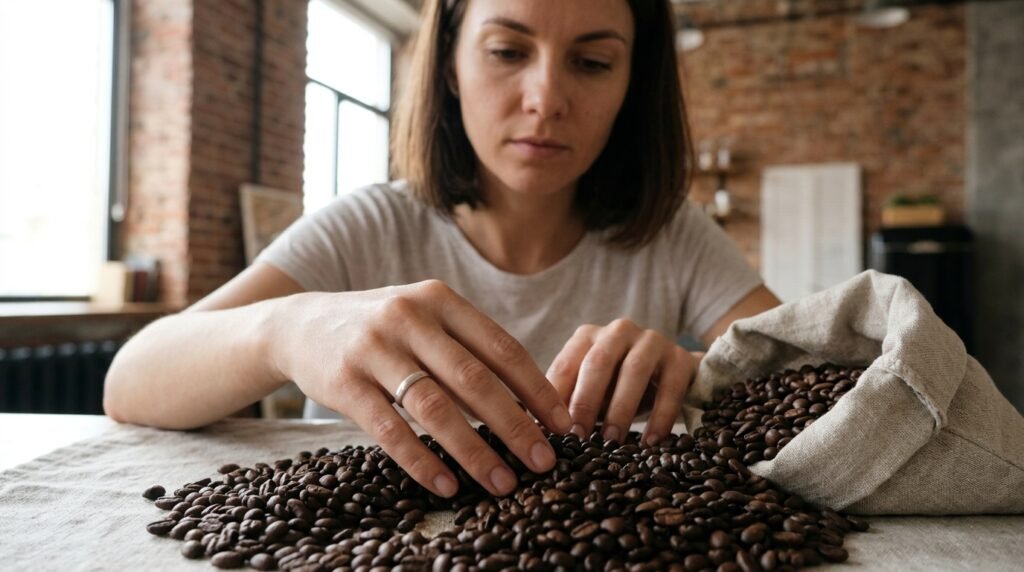
Pour a few whole beans into your hand. Notice the weight. Squeeze them between your fingers to test their density. When you grind them, pay close attention to the texture of the resulting particles. Do they feel damp and heavy, or do they feel like dry, static dust?
When you pour the hot water, watch the surface of the coffee bed. Look for the massive, bubbling dome of escaping gas. Look for the physical resistance.
When you finally take a sip, do not just swallow it immediately. Let the liquid sit on your tongue. Feel the weight of the water. Feel the coating of the natural oils.
When you learn to pay attention to the physical cues, you realize that fresh coffee announces itself loudly. It fights the grinder. It fights the water. It coats your palate. It is a dense, heavy, living piece of agriculture. Stop treating it like a dead pantry staple, and start respecting the incredible physical reality of the fresh seed.
