
I spent my Saturday morning organizing my digital workspace. I build complex automations for multiple websites during the week. I like to keep my personal life just as organized. I decided to build a database to track all the specialty coffee I purchase.
I walked into my kitchen and pulled a large storage bin out of the pantry. It was filled with empty coffee bags. I keep them so I can remember which farms and varieties I enjoy the most.
I laid the empty bags out on the kitchen table in Rio de Janeiro. I opened my laptop and started typing the data into a spreadsheet. I logged the country of origin. I logged the altitude. I logged the processing method.
Then I tried to log the roast profile. My spreadsheet completely failed.
The terminology printed on the bags was an absolute disaster. One bag said “Filter Roast.” Another bag said “City Roast.” A third bag said “Omni Roast.” A bag of dark commercial coffee simply said “French Roast.” There was no universal standard. The labels were a confusing mess of marketing jargon.
I closed my laptop. I realized I did not actually understand what any of those words meant in a physical sense. The day I finally understood coffee roast profiles happened later that afternoon. I stopped reading the marketing labels and started looking at the actual chemistry of the seed. It completely changed how I operate my morning kitchen.
The Confusion of the Label
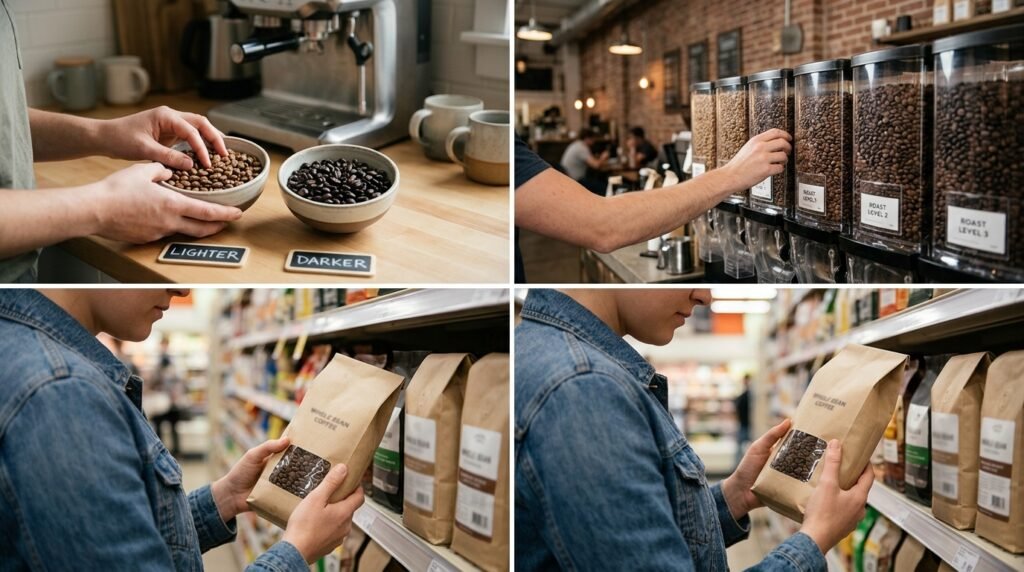
When you walk into a grocery store or a specialty cafe, the packaging actively tries to confuse you.
Coffee companies invent words to sell their products. They use terms like “Vienna Roast” or “Italian Roast” to sound sophisticated. They use terms like “Blonde” or “Bold” to appeal to different demographics. None of these words are scientifically accurate. They are completely subjective.
One roaster might label a coffee as a medium roast. A different roaster down the street might take that exact same coffee and label it as a light roast.
Navigating this confusing terminology was the exact premise of What I Noticed When I Started Paying Attention to Coffee Labels because the marketing words actively hide the physical reality. You cannot rely on the text printed on the bag. You have to rely on your own eyes.
Seeking Visual Proof
I left my apartment and walked to a local independent roastery. I needed a professional to translate the jargon.
I found the head roaster working near a massive cast iron drum. I asked him to explain the difference between a filter roast and an espresso roast. I asked him what “Full City” actually meant.
He smiled and told me to forget all the terminology. He said those words are just arbitrary markers on a strict chemical timeline.
He walked into the back room and returned with three small glass bowls. He placed them on the counter. He told me he was going to show me the exact same coffee bean stopped at three different points on the timeline.
The Raw Green Baseline
Before he showed me the roasted coffee, he showed me the raw material.
He poured a handful of raw, green coffee seeds into my hand. They were incredibly dense. They felt like small, hard pebbles. I brought them to my nose. They smelled entirely like dry hay and fresh green peas. There was absolutely zero sweetness.
He explained that the green seed holds all the potential flavor. The volcanic soil and the extreme altitude of the farm pack the seed with complex carbohydrates and organic acids.
But those flavors are locked inside a biological vault. You cannot extract them with hot water. You have to use extreme thermal energy to break the vault open. The roasting drum is the key.
The Catalyst of the First Crack
When the green seeds drop into the hot metal drum, they absorb a massive amount of heat.
The moisture trapped inside the dense seed turns into steam. The internal pressure builds rapidly. Eventually, the cellular structure of the coffee bean cannot hold the steam anymore. The bean forcefully shatters open.
This creates a loud popping sound inside the roasting machine. It sounds exactly like popcorn. The industry calls this the first crack.
The first crack is the absolute starting line for drinkable coffee. Before this pop, the coffee is raw and entirely useless. After this pop, the sugars begin to caramelize. The roaster must carefully decide how long to leave the beans in the heat after this initial explosion.
Profile One: The Light Roast
The roaster pointed to the first glass bowl on the counter. He called this a light roast. Some companies call it a filter roast. Some call it a blonde roast.
He explained that he stopped the roasting machine exactly sixty seconds after the first crack ended.
I looked at the beans in the bowl. They were a pale, matte tan color. Their surface was completely dry. There was absolutely zero oil visible anywhere. They looked small and tightly packed.
A light roast is designed to protect the agricultural origin of the plant. The heat was applied just long enough to make the sugars soluble. The intense fire was stopped before it could incinerate the delicate fruit acids and the fragile floral compounds.
When you drink a light roast, you taste the specific dirt of the farm. You taste the bright lemon acidity and the sweet peach flavors. The roaster gets completely out of the way.
Profile Two: The Medium Roast
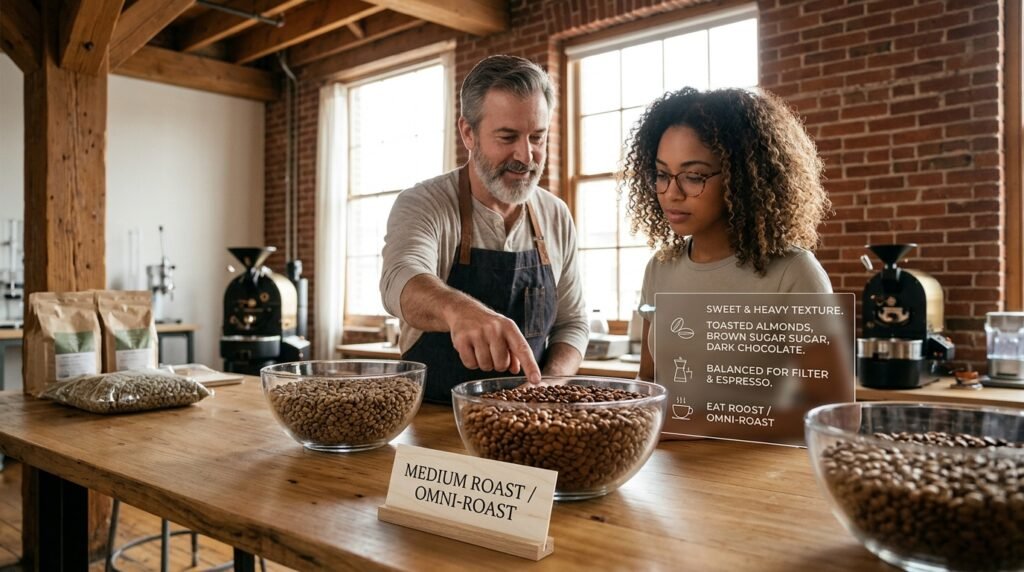
The roaster pointed to the second glass bowl. He called this a medium roast. Many modern cafes call this an omni roast because it works well for both filter coffee and espresso.
He explained that he left these beans in the hot drum for about two and a half minutes after the first crack ended.
I looked closely at the beans. They were a rich, warm brown color. They looked exactly like milk chocolate. The surface was still mostly dry, but they looked slightly larger and more expanded than the light roast.
The medium roast is a deliberate compromise. The extra time in the oven burns away the sharp, bright fruit acids. The intense floral notes evaporate.
In exchange for losing the bright acidity, the simple sugars undergo massive caramelization. The coffee becomes incredibly sweet and heavy. It tastes like toasted almonds, brown sugar, and dark chocolate. It is deeply comforting and heavily textured.
The Warning of the Second Crack
If the roaster leaves the beans in the machine past the medium stage, the heat becomes extreme.
The cellular structure of the bean begins to completely collapse under the intense thermal energy. A second violent popping sound occurs inside the drum. This is called the second crack.
The second crack is a destructive event. The extreme heat forces the internal oils to boil. The oils push through the broken, shattered cell walls and coat the outside of the bean. The plant material begins to rapidly carbonize.
Profile Three: The Dark Roast
The roaster pointed to the final glass bowl on the counter. He called this a dark roast. Traditional companies often call it a French roast or an Italian roast.
He left these beans in the drum well past the second crack.
The beans looked entirely different. They were pitch black. They were covered in a thick, slick layer of heavy grease. They left dark, oily smudges on the white counter. They were visibly puffed up and swollen.
A dark roast is the complete destruction of the agricultural origin. The intense fire has incinerated all the natural fruit acids. The complex sugars are burned into carbon.
When you drink a dark roast, you do not taste the farm. You do not taste the volcanic soil or the altitude. You only taste the roasting oven. The flavor is heavy, smoky, and aggressively bitter. It tastes exactly like ash and charred wood.
The Density Difference
The most important lesson I learned that day was not about flavor. It was about physical physics.
The roast profile completely changes the structural density of the coffee bean.
I picked up a light roasted bean and tried to crush it between my fingers. It was impossible. The bean was solid and incredibly hard. Because the roaster pulled it out of the oven early, it retained its tight cellular structure.
I picked up a dark roasted bean and squeezed it. It shattered instantly into black powder. It was completely hollow and incredibly brittle. The extreme heat of the oven had destroyed its internal integrity.
The Mistake in the Kitchen
Understanding this physical difference completely changed my morning routine.
You cannot treat a dense seed and a brittle seed exactly the same way. Treating every bean identically was The Simple Coffee Mistake I Made Every Morning for Years and it ruined hundreds of expensive bags. You have to adapt your equipment to the roast profile.
If you use a manual hand grinder, you will immediately feel the profile. A light roast will fight you. You have to use real physical force to turn the handle. A dark roast will offer zero resistance. The burrs will slice through the brittle beans like dry leaves.
Because dark roasts shatter so easily, they create massive amounts of microscopic coffee dust. This dust clogs your paper filters and causes your extraction to stall. You must grind dark roasts significantly coarser to prevent this mechanical failure.
The Temperature Rule
The physical density also dictates the temperature of your water.
A light roast actively resists extraction. The tight cellular walls do not want to let the water inside. If you use lukewarm water, you will fail. The water will only wash the sour, sharp acids off the surface of the bean. You will completely miss the heavy, sweet sugars trapped inside the core.
You must use violently boiling water to brew a light roast. You need massive thermal energy to break into the dense seed.
A dark roast demands the exact opposite treatment. The shattered, highly porous cell walls act like a massive sponge. Water rushes inside instantly. If you use boiling water on a dark roast, you will violently over extract the carbonized material. You will pull massive amounts of dry, harsh tannins into your mug.
You must drop your kettle temperature for darker profiles to avoid pulling bitter flavors. Mastering this thermal variable is exactly How I Learned Coffee Temperature Changes Flavor in my daily routine. The roast profile controls the kettle.
Trusting Your Eyes
I walked out of the roastery and threw my digital spreadsheet idea away.
I realized that logging arbitrary marketing words is completely useless. The only thing that matters is the physical reality of the seed.
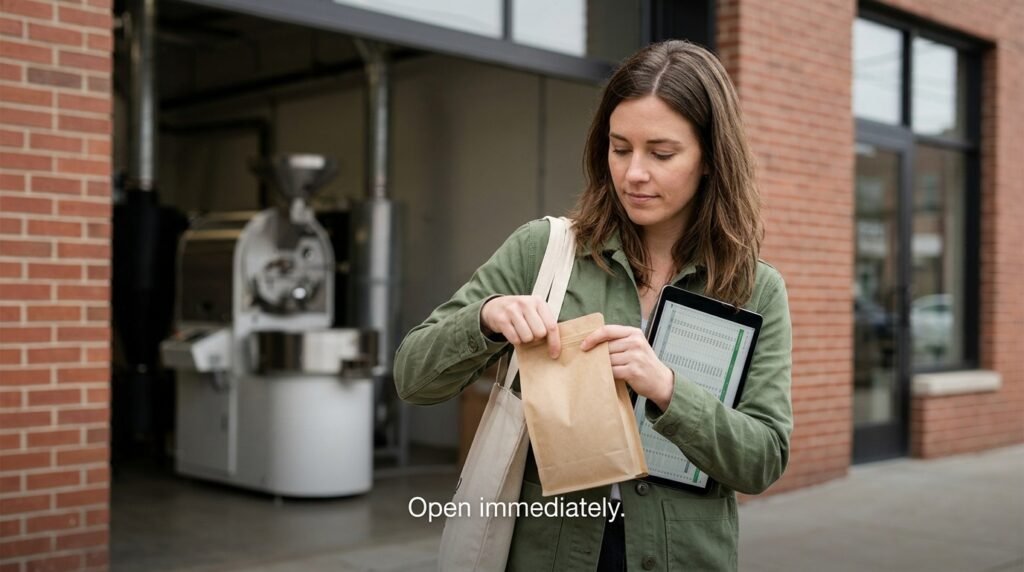
When you buy a new bag of coffee, open it immediately. Pour a handful of beans into the palm of your hand. Look at the color. Look for the presence of surface oils. Feel the density of the bean in your grinder.
Your eyes and your hands will tell you exactly how the coffee was roasted. They will tell you exactly what water temperature you need to use.
Taking Total Control
We often view coffee brewing as a game of luck. We buy a bag, follow the instructions on the back, and hope the liquid tastes good.
You do not have to rely on hope. You can rely on physics.
The roast profile is the instruction manual. A light, matte brown bean tells you to use boiling water, a finer grind, and a slow pour. A dark, oily bean tells you to use cooler water, a coarser grind, and a fast pour.
Stop reading the confusing jargon printed on the front of the packaging. Ignore the words “City” or “French.” Look at the actual ingredient. Once you understand how the heat of the oven permanently alters the density of the seed, you gain absolute control over your kitchen. You will stop guessing, and you will start brewing with deliberate, scientific precision.
