
I woke up on a Sunday morning to a completely silent apartment. The sun was just starting to light up the living room. I reached over to my nightstand to check the time on my smartphone. The screen was completely black.
I pushed the power button. A flashing red battery icon appeared and then vanished.
I had forgotten to plug the phone into the charger the night before. My immediate instinct was to jump out of bed, find the charging cable, and plug it into the wall. I felt a sudden, strange panic at being disconnected from the digital world.
I sat on the edge of the bed and took a deep breath. I decided to ignore the dead phone. It was Sunday. I had absolutely nowhere to be. I did not need to check my email. I did not need to scroll through social media.
I walked into my kitchen to make my morning coffee. I gathered my gear. I grabbed my glass pour over cone. I grabbed my digital kitchen scale.
I hit the power button on the scale. The numbers lit up. But I quickly realized a massive problem. My digital scale only measures weight. It does not have a built in stopwatch. I always used the timer application on my smartphone to track my coffee extraction.
My phone was dead in the bedroom. I had no clock on the wall. I had no watch on my wrist.
I stood in the quiet kitchen and stared at my equipment. For months, I had been an absolute slave to the numbers. I tracked every single second of the brew. I panicked if my extraction went ten seconds over my target time. Now, I was completely blind. The first time I tried brewing coffee without a timer forced me to completely abandon my mathematical crutches. It forced me to finally trust my own physical senses.
The Tyranny of the Screen
Before this quiet Sunday morning, my brewing routine was incredibly rigid.
I treated the pour over process like a hostile bomb defusal. I kept my eyes glued to the digital screen of my phone. I watched the seconds tick upward. I poured the water mechanically, trying to match my physical movements to the cold digital numbers.
If the timer hit forty five seconds, I started pouring. If the timer hit two minutes, I stopped pouring.
I thought this strict adherence to the clock was making my coffee better. But I was missing the entire point of manual brewing. I was completely ignoring the actual coffee. I was not looking at the grounds. I was not smelling the aroma. I was only looking at a glowing rectangular screen.
I was acting like a machine. I had completely removed the human element from my own kitchen.

Prepping the Raw Ingredient
I decided to embrace the silence. I was going to brew the coffee entirely by feel.
I grabbed a beautiful bag of lightly roasted Ethiopian Guji beans. This specific coffee is incredibly delicate. It is famous for complex floral notes and a bright, juicy peach acidity. It requires a gentle extraction.
I placed my manual hand grinder on the digital scale. I weighed exactly twenty grams of the whole beans. I locked the grinder and turned the metal handle. I listened to the ceramic burrs crush the hard seeds.
The physical effort of grinding by hand felt grounding. When I finished, I opened the catch bin. A massive wave of dry aroma filled the kitchen. It smelled intensely of fresh jasmine flowers and raw honey.
I placed a paper filter into my glass cone and rinsed it with hot water from my kettle. I dumped the rinse water into the sink. I poured the dry Ethiopian coffee grounds into the damp filter. I tapped the glass to level the coffee bed.
I was ready to begin the blind extraction.
The Visual Bloom
I took my gooseneck kettle off the stove. I waited a moment for the aggressively boiling water to calm down.
I poured a very small splash of hot water over the dry coffee grounds to start the bloom phase. I placed the kettle back down on the stove.
Usually, this is the exact moment I would stare at my phone. I would wait for the digital timer to reach forty five seconds. Without the screen, I had to actually look down into the glass cone.
I watched the coffee react. The dark grounds swelled upward. They bubbled and expanded rapidly as the trapped carbon dioxide gas escaped. The surface looked like a thick, bubbling chocolate cake.
I kept watching. After a short while, the aggressive bubbling stopped. The surface of the coffee bed started to look slightly dry. The dark mahogany color began to fade into a lighter, duller brown. The coffee was visually telling me that the gas was gone. The coffee was telling me it was thirsty for more water.
I did not need a clock to tell me the bloom was finished. The physical ingredient provided a perfect visual cue.
Pouring by Intuition
I picked the kettle back up. It was time for the main extraction phase.
In my old routine, I would pour water to hit specific weight milestones at specific second markers. Now, I had to rely entirely on my own internal rhythm.
I started pouring the hot water in slow, tight, concentric circles. I kept the spout of the kettle very close to the coffee bed. I watched the water level rise inside the paper filter.
I focused completely on the physical flow of the liquid. I made sure the water did not splash aggressively. I made sure the dark foam on the surface stayed perfectly intact. I managed the water level entirely by sight.
I realized that my hands already knew exactly what to do. I had developed muscle memory over months of daily practice. Allowing my muscle memory to take over was the core lesson from How I Learned to Time My Coffee Pour Perfectly during my early training. My body understood the correct speed. My brain just needed to get out of the way.

The Olfactory Shift
As I continued pouring the water, I noticed something incredible happening in the air.
Because my eyes were not glued to a digital screen, my other senses were highly elevated. I started paying close attention to the steam rising from the glass cone.
The aroma of the coffee actually changed as the extraction progressed.
During the initial bloom, the smell was sharp and highly acidic. It smelled like bright lemon zest. As I poured more water, that sharp acidity began to mellow. The steam started smelling much sweeter. The scent of ripe peaches and heavy caramelized sugar filled the kitchen.
This olfactory shift is a known chemical phenomenon. The bright fruit acids dissolve first. The heavy, sweet sugars dissolve second. I had never actually noticed this transition before. I was always too distracted by the timer.
The smell of the steam was an active indicator of the extraction phase. The coffee was communicating with me.
Listening to the Drip
I kept pouring until the digital scale hit my target weight of three hundred and twenty grams. I put the kettle down.
The final phase of the pour over is the drawdown. You wait for the remaining water to drip through the coffee bed into the mug.
Normally, I would pace around the kitchen anxiously. I would watch the timer hit the three minute mark. If the water was still dripping at three minutes and thirty seconds, I would panic and assume the cup was ruined.
Without the timer, I just stood perfectly still. I closed my eyes.
I listened to the sound of the liquid hitting the bottom of the ceramic mug. The sound started as a steady, heavy stream. Then it slowed into a fast drip. Then it slowed into a rhythmic, individual drop. Plink. Plink. Plink.
When the sound stopped completely, I opened my eyes. The coffee bed was perfectly flat and dry. The extraction was finished. The process took exactly as long as it needed to take.
The Moment of Truth
I removed the glass cone and threw the paper filter into the trash can. I picked up the warm ceramic mug.
The liquid was a beautiful, translucent ruby color. It looked perfectly clean.
I walked over to my kitchen table and sat down. The morning sun was shining brightly through the window. My phone was still completely dead in the other room. The silence was heavy and comforting.
I brought the mug to my lips and took a slow sip.
I closed my eyes to process the flavor. It was absolutely magnificent.
The coffee was incredibly sweet. The delicate notes of peach and jasmine were vibrant and clearly defined. The texture was soft and syrupy. There was no harsh, astringent bite. There was no muddy, burnt bitterness. It was perfectly balanced.
It might have taken two minutes and fifty seconds to brew. It might have taken three minutes and twenty seconds. I had absolutely no idea. And for the first time in my life, I realized that the exact number did not matter at all.
Escaping the Metric Trap
We live in a world completely obsessed with metrics. We track our daily steps. We track our heart rates. We track our sleep cycles on smart watches. We constantly optimize our lives using digital numbers.
Bringing that metric obsession into the kitchen is a massive mistake.
Coffee is an agricultural product. It is grown in dirt. It is affected by rain, altitude, and unpredictable weather patterns. It is a wild, natural ingredient.
You cannot force a wild ingredient to conform perfectly to a digital stopwatch. Sometimes the coffee needs a little more time to give up its sugar. Sometimes it extracts very quickly.
When you brew blindly, you learn to read the physical signs. You learn to adapt. Trusting your senses over the numbers is precisely The Simple Coffee Change That Made Every Cup Better and permanently elevated my daily results. You become a chef instead of a calculator.
The Return to the Craft
I eventually walked into my bedroom, found my charging cable, and plugged my phone into the wall. The digital world rushed back in with a flood of notifications and emails.
But my perspective on my morning routine had completely shifted.
I did not throw my digital scale away. I still use it to weigh my beans and my water. Having a solid mathematical baseline for your ingredients is absolutely crucial for consistency.
But I permanently deleted the stopwatch application from my coffee routine.
I no longer care how many seconds the bloom takes. I no longer care how long the total extraction lasts. I trust my eyes to watch the coffee expand. I trust my nose to smell the sweet sugars releasing. I trust my hands to maintain a steady, calm pour.
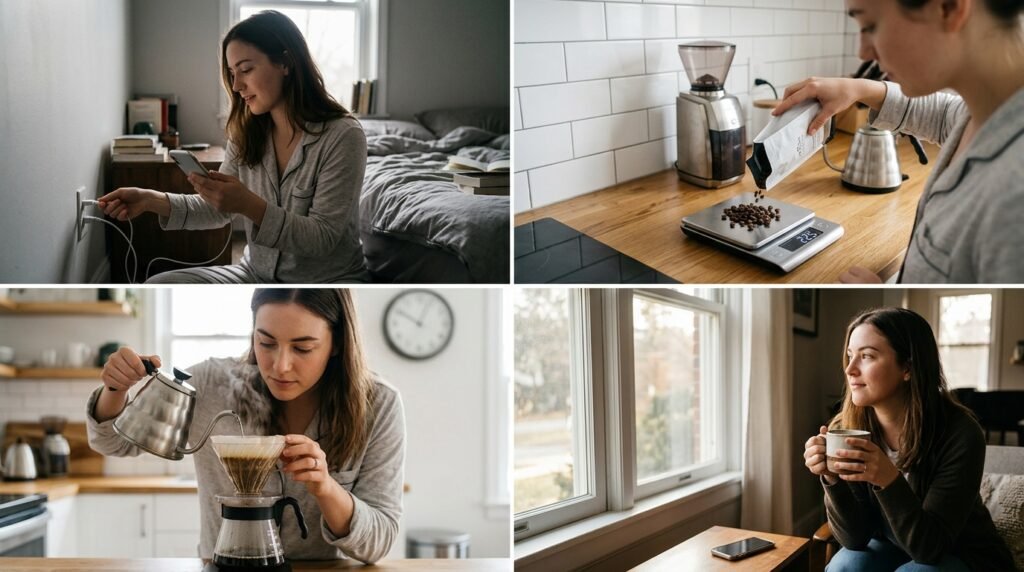
A Meditative Start to the Day
Removing the timer from the brewing process provides a massive psychological benefit.
When you stop racing against a clock, the anxiety disappears entirely. Making coffee stops feeling like a timed laboratory test. It becomes a fluid, tactile craft.
You are forced to be entirely present. You cannot check your text messages while you pour. You must engage with the physical world in front of you. This deliberate, analog practice became The Coffee Routine That Helped Me Slow Down before the heavy stress of the workday begins. It is a mandatory ten minutes of peace.
If your morning coffee feels like a stressful chore, I highly encourage you to unplug.
Tomorrow morning, leave your smartphone in the bedroom. Do not look at the clock on your oven. Weigh your beans, boil your water, and just watch the reaction. Let the coffee tell you when it is ready. You will discover a level of sweetness and clarity in your mug that a digital timer simply cannot provide. You will rediscover the absolute joy of manual brewing.
