
I was in my sister’s kitchen on a Saturday afternoon. I was helping her bake a massive chocolate cake for a family birthday party. I grabbed a plastic measuring cup, scooped a large pile of flour out of the bag, and moved to dump it into the mixing bowl.
She physically stopped my hand. She told me I was going to ruin the entire cake.
She pulled a flat, digital glass scale out of a drawer. She placed a small metal bowl on top of the scale and pressed a button to zero it out. She took a spoon and carefully added flour to the bowl until the digital display read exactly two hundred and fifty grams.
She explained that volume is a massive lie. A cup of densely packed flour contains significantly more physical mass than a cup of loosely scooped flour. If you want the chemical reactions of baking to work properly, you cannot guess the volume. You have to measure the exact physical weight.
I stood in her kitchen and felt a sudden wave of clarity hit me.
I went home and looked at the coffee station on my kitchen counter. I looked at the cheap plastic scoop sitting inside my bag of expensive coffee beans. I realized I was treating my morning coffee like a casual pot of soup. I was just throwing random handfuls of ingredients together and hoping for the best.
Coffee is not soup. Coffee is baking. Coffee is strict, unforgiving chemistry. The very next day, I bought a digital kitchen scale. The first time I measured my coffee and water, the chaotic bitterness of my mornings vanished permanently.
The Problem with the Plastic Scoop
To understand why my coffee tasted so inconsistent, I had to completely abandon my old habits.
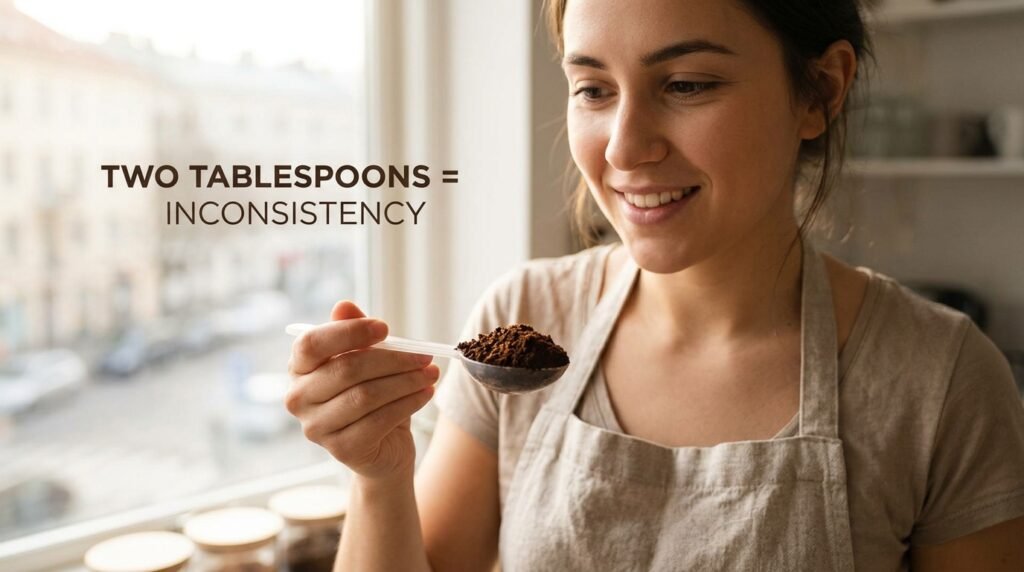
For years, I relied on a simple plastic tablespoon. The instructions on the back of my coffee bag told me to use two tablespoons of coffee for every cup of water. I followed those instructions blindly.
I assumed a scoop of coffee was a universal measurement. I was completely wrong.
Coffee beans are an agricultural product. They vary wildly in physical size, shape, and density. A coffee bean grown high up on a mountain in Ethiopia is incredibly small and dense. A coffee bean grown at a lower altitude in Brazil is much larger and significantly lighter.
Furthermore, the roasting process changes the physical structure of the bean. When a coffee roaster applies extreme heat to a bean, the internal moisture boils. The bean physically expands and puffs up.
A very dark roasted bean is much larger and much less dense than a light roasted bean.
The Illusion of Volume
This variance in physical density completely destroys the concept of volume measurement.
If I take my plastic tablespoon and scoop up a pile of light roast Ethiopian beans, that scoop might weigh exactly fifteen grams. The dense little seeds pack tightly together inside the plastic spoon.
If I take that exact same plastic tablespoon and scoop up a pile of dark roast Brazilian beans, that scoop might only weigh ten grams. The puffed up, airy beans take up a lot of visual space, but they carry very little actual mass.
If I use the exact same two scoops every morning, I am actively changing my recipe based entirely on the brand of coffee I buy.
One week, I might be using thirty grams of coffee. The next week, I might only be using twenty grams of coffee. That is a massive mathematical swing. If your core ingredient fluctuates by thirty percent every single week, your flavor will always be a chaotic mess.
Buying the Right Equipment
I knew I had to eliminate this hidden variable. I went online and ordered a digital scale.
I did not buy an expensive, complicated scale. I just bought a simple, flat baking scale that measured in single grams. It cost me fifteen dollars. It was a tiny financial investment, but it offered a massive return in culinary control.
When the box arrived, I unpacked the scale and placed it permanently on my kitchen counter. It felt strange to bring a piece of laboratory equipment into my morning routine. I was used to operating on autopilot.
But I committed to the process. Documenting this specific shift in behavior became the foundation for The First Week I Brewed Coffee with Precision Scales during my journey. I forced myself to stop guessing. I forced myself to look at the hard numbers.
The Shock of the First Weigh In
The next morning, I conducted a brutal reality check.
I took my old plastic scoop. I scooped what I thought was a normal amount of coffee beans. I dumped the beans onto the digital scale. The screen read eighteen grams.
I dumped the beans back into the bag. I scooped another pile of coffee using the exact same physical motion. I dumped them onto the scale again. The screen read fourteen grams.
My jaw dropped slightly. My physical hand movements were incredibly inconsistent. Even when I tried to scoop the exact same amount of volume, the actual mass fluctuated wildly.
I finally understood why my coffee tasted great on Tuesday and tasted like bitter water on Wednesday. I was completely out of control. I threw the plastic scoop directly into the trash can. I decided I would never rely on volume to brew coffee ever again.
Establishing the Golden Baseline
Now that I had a tool to measure mass, I needed to establish a mathematical baseline. I needed a recipe.
In the specialty coffee world, recipes are not written in scoops or cups. They are written in ratios. A brew ratio is the exact mathematical relationship between the weight of the dry coffee and the weight of the hot water.
The globally accepted starting point for pour over coffee is a ratio of 1 to 16. That means for every one gram of coffee, you need sixteen grams of water.
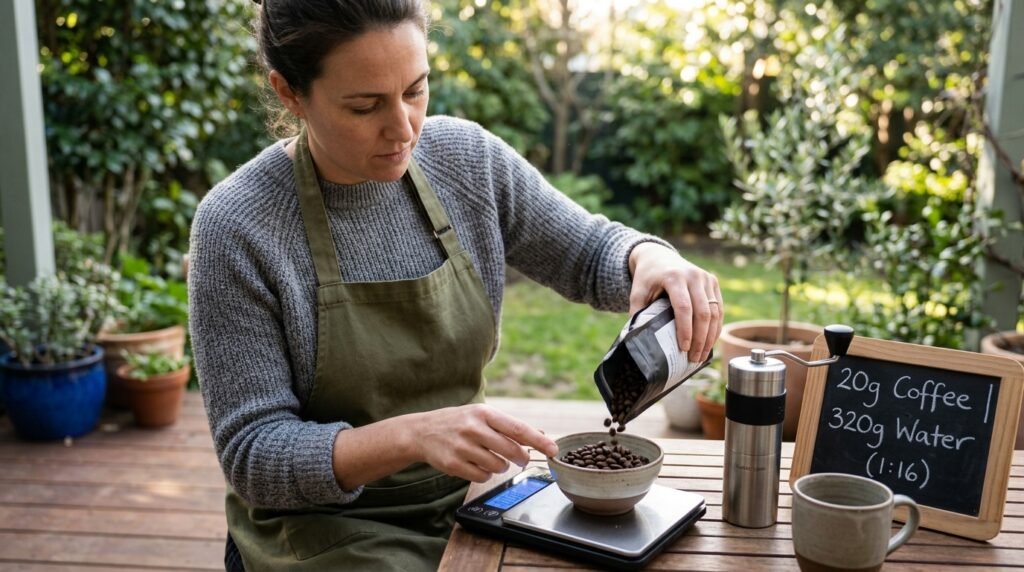
I decided to start there. I wanted a standard, medium sized mug of coffee. I decided to use exactly twenty grams of coffee beans.
I placed a small bowl on my digital scale. I pressed the tare button. The screen dropped to zero. This is the magic of a digital scale. You can zero out the weight of the container and only measure the ingredients inside.
I carefully poured whole coffee beans into the bowl until the screen read exactly twenty grams. I poured the beans into my manual grinder and crushed them into a uniform powder.
The Delusion of the Glass Pot
I had successfully locked down the coffee variable. But coffee is only half of the equation. The other half is the water.
In my old routine, I would measure my water by looking at the printed lines on the side of my glass coffee pot. I would fill the pot up to the line that said “two cups” and dump it into my kettle.
This was my second massive failure.
The printed lines on a commercial glass coffee pot are notoriously inaccurate. The manufacturers paint those lines quickly and cheaply on an assembly line. Furthermore, a “cup” in the coffee machine industry is almost never a standard eight ounce measuring cup. Some manufacturers define a cup as five ounces. Some define it as six ounces.
It is a completely lawless system of measurement.
I realized I could not trust the painted lines on a piece of glass. I had to trust the gravity pulling down on the scale. Water has physical mass. One milliliter of water weighs exactly one gram. The math is beautifully simple.
Measuring the Solvent
I placed my glass pour over cone on top of a ceramic mug. I placed the entire tower onto my digital scale. I added a paper filter and rinsed it with hot water.
I dumped my twenty grams of freshly ground coffee into the damp filter.
I pressed the tare button. The scale dropped back to zero. The scale was now ignoring the weight of the mug, the glass cone, the wet paper, and the dry coffee. It was a blank slate.
I grabbed my gooseneck kettle full of hot water. I knew my math. I had twenty grams of coffee. I was using a 1 to 16 ratio. Twenty multiplied by sixteen is three hundred and twenty.
I needed to pour exactly three hundred and twenty grams of hot water.
The Precision Pour
I started pouring the hot water over the coffee grounds.
Watching the numbers climb on the digital display completely changed my psychological approach to brewing. I was no longer a passive bystander hoping the machine would do a good job. I was an active participant in a chemical reaction.
I poured sixty grams of water to start the bloom phase. I stopped pouring and watched the coffee swell.
After forty five seconds, I resumed pouring. I poured slowly and evenly in tight concentric circles. I kept my eyes glued to the digital display. I watched the numbers tick upward. Two hundred grams. Two hundred and fifty grams. Three hundred grams.
When the screen hit exactly three hundred and twenty grams, I pulled the kettle away.
I stood there and watched the final drops of liquid fall through the filter into the mug. I had executed the extraction with absolute mathematical precision.
The Taste of Certainty
I removed the glass cone and tossed the paper filter in the trash. I picked up the ceramic mug.
I took a slow sip. The flavor was spectacular.
It was incredibly balanced. It was neither weak nor violently strong. It had a heavy, sweet body with a bright, crisp finish. I could taste the specific notes of caramel and red fruit that the roaster promised on the bag.
But the most incredible part of the experience was not the flavor itself. The most incredible part was the certainty.
I knew that because I had measured the mass of both ingredients perfectly, I could replicate this exact cup of coffee tomorrow. I could replicate it next week. I had captured lightning in a bottle, and I had the mathematical formula to do it again and again. Establishing this absolute certainty was the core premise of What I Learned About Coffee Measurement Accuracy and why I refuse to brew blindly ever again.
The Power of Diagnostics
Using a digital scale did more than just guarantee consistency. It gave me a diagnostic tool.
If you do not measure your ingredients, you cannot fix a bad cup of coffee. If you make a cup that tastes incredibly sour and weak, what do you do the next day? Do you add more coffee? Do you add less water? You do not know, because you do not know how much you used the first time. You are just guessing in the dark.
When you know your exact numbers, fixing a bad cup is incredibly easy.
If I brew a new bag of beans with my standard recipe and it tastes slightly too bitter, I do not panic. I simply change the math. The next morning, I keep my water weight at three hundred and twenty grams, but I reduce the coffee weight to eighteen grams.
I deliberately widen the ratio. I track the change. I taste the result.
Because I know my numbers, I can steer the flavor profile exactly where I want it to go.
The End of the Dark Ages
I cannot overstate how important this transition was for my daily routine.
Buying that fifteen dollar scale fundamentally elevated my kitchen. Finding the exact device I needed was exactly The Tool That Helped Me Measure Coffee Like a Pro and ended my reliance on cheap plastic scoops. It moved me out of the culinary dark ages.
Coffee beans are an expensive luxury. It is incredibly foolish to spend twenty dollars on a bag of premium, single origin beans only to ruin them with sloppy, inaccurate volume measurements. You are throwing your money straight into the garbage.
You would never try to bake a delicate pastry by throwing random handfuls of flour and sugar into an oven. You would measure the ingredients. Coffee demands that exact same level of respect.

Stop Guessing the Mug
If you are currently frustrated by the wild inconsistency of your morning coffee, the solution is not a new coffee machine. The solution is not a different brand of beans.
The solution is math.
Go online right now and buy a simple digital kitchen scale. Throw away your plastic scoops. Throw away your measuring cups. Stop looking at the painted lines on the side of your glass coffee pot.
Tomorrow morning, weigh your beans in grams. Weigh your water in grams. Lock in your ratio. Taste the liquid.
Once you experience the absolute peace of mind that comes from mathematical precision, you will never go back. You will stop guessing, you will start knowing, and your morning mug will finally become a reliable masterpiece.
