
I was building a complex grid layout for a client website on a warm afternoon in Rio de Janeiro. The design required absolute mathematical perfection. I needed three columns to align exactly across the screen. If one column was a single pixel too wide, the entire layout would break. The code would push the final box down to the next row and ruin the visual harmony entirely.
In digital architecture, you cannot estimate spacing. You cannot guess the width of a container. You must assign a strict, absolute numerical value to every single element.
I pushed away from my computer desk and walked into the kitchen to clear my head. I looked at my manual coffee grinder and my bag of light roasted Ethiopian beans. For years, I completely ignored the strict numerical logic of my profession when I entered the kitchen. I estimated my coffee. I guessed the water volume.
What I learned after measuring my coffee properly completely exposed my own culinary ignorance. It taught me that coffee is bound by the exact same strict mathematical rules as computer code. When I finally started tracking the raw physical mass of my ingredients, the mystery of the bad extraction vanished completely.
The Deception of Volume
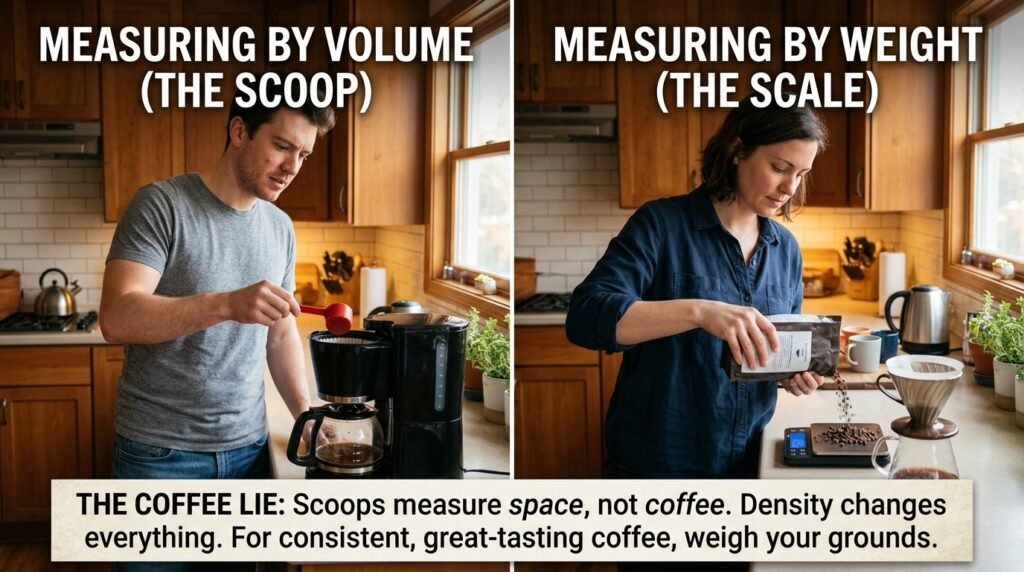
The greatest lie in the coffee industry is the plastic measuring scoop.
We are taught to use volume to brew coffee. We read instructions that tell us to put two rounded scoops of coffee grounds into the filter for every mug of water. This volumetric system is completely broken because it ignores the fundamental laws of agricultural density.
A plastic scoop only measures empty physical space. It tells you absolutely nothing about the actual weight of the organic material occupying that space.
If you fill a scoop with heavy, wet sand, it will weigh significantly more than the exact same scoop filled with dry feathers. The volume is identical. The mass is completely different.
The Density of the Roast
Coffee beans possess wildly different physical densities based on their origin and their roast profile.
I drink high altitude Ethiopian coffee. Because it grows high in the mountains and is roasted very lightly, the cellular structure of the seed remains incredibly tight. The beans are very small, dense, and heavy. They are agricultural rocks.
Dark roasted coffee is entirely different. The roaster applies extreme heat for a long period. The beans violently expand. They puff up and become completely hollow. They lose massive amounts of water weight.
Exposing the Margin of Error
I decided to test this physical reality. I placed a glass bowl on my new digital scale.
I took my plastic scoop and filled it completely level with the dense Ethiopian beans. I dumped the beans into the bowl. The digital screen read thirteen grams.
I emptied the bowl. I grabbed a bag of old, dark roasted Brazilian beans. I filled the exact same plastic scoop until it was perfectly level. I dumped the hollow beans into the bowl. The digital screen read eight grams.
My visual estimation system had a margin of error of nearly fifty percent. Surviving that frustrating period of terrible extractions was the core lesson behind The First Week I Brewed Coffee with Precision Scales because I finally saw the hard numbers proving my total lack of control. I was extracting wildly different amounts of actual coffee mass every single morning.
The Chemistry of the Ratio
Once you understand that volume is a liar, you must switch entirely to mass. You must weigh everything in grams.
Coffee extraction relies on a strict chemical relationship between the solid organic material and the hot liquid solvent. The specialty coffee industry refers to this relationship as the brew ratio.
A standard, highly balanced pour over ratio is one to sixteen.
This means you need one gram of coffee mass for every sixteen grams of water mass. This specific mathematical balance ensures the hot water pulls out the sweet fruit sugars without over extracting the harsh, bitter tannins hidden deep inside the seed.
Establishing the Baseline
The digital scale allowed me to lock this mathematical baseline into reality.
I placed my manual burr grinder on the scale and pressed the zero button. I poured my dense Ethiopian beans into the top chamber until the screen hit exactly fifteen grams. There was no visual guessing. I had an absolute numerical value.
I ground the beans and placed my plastic V60 cone onto the scale.
If I had fifteen grams of coffee, the math was simple. Fifteen multiplied by sixteen is two hundred and forty. I needed exactly two hundred and forty grams of hot water to execute the extraction correctly.
The Trap of the Output Liquid
Measuring the water requires a specific physical understanding of the brewing environment.
Before I used a scale, I would boil water and pour it over the coffee grounds until my heavy ceramic mug looked full. I was measuring the output liquid by eye. This is a massive chemical mistake.
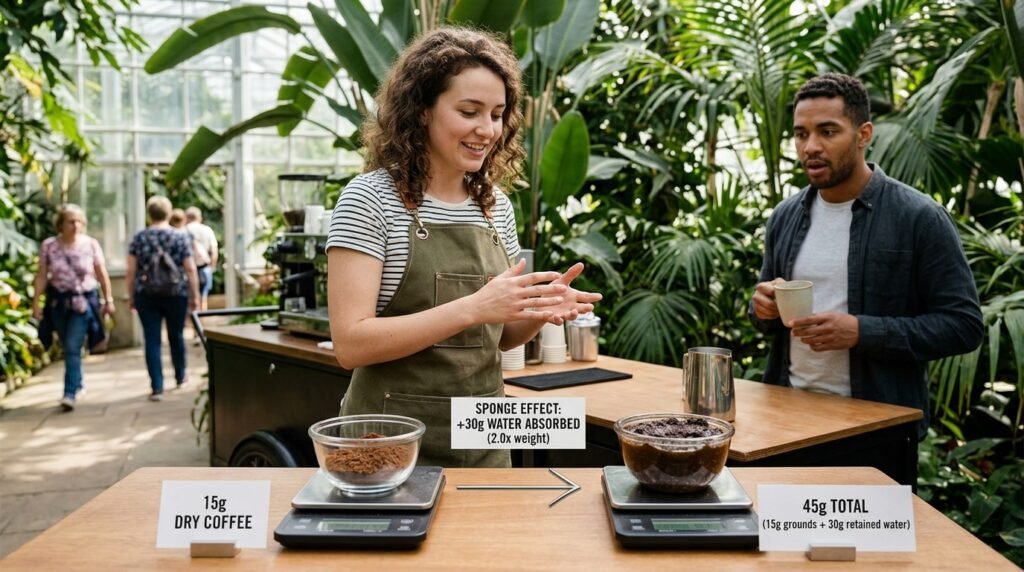
Coffee grounds act like a sponge. They permanently absorb and hold exactly twice their own weight in water.
If I put fifteen grams of dry coffee into the filter, those grounds will trap thirty grams of water. That liquid will never reach the ceramic mug. Grasping this exact liquid retention principle was exactly What I Learned About Coffee Measurement Accuracy and it completely changed how I managed my kettle.
Watching the Input Data
You cannot measure the liquid in your cup. You must measure the water leaving your kettle.
I placed the entire brewing setup on the digital scale. I zeroed the numbers. I grabbed my gooseneck kettle and started pouring the hot water over the coffee bed.
I completely ignored the liquid level inside the ceramic mug. I kept my eyes locked exclusively on the digital numbers climbing on the scale screen. One hundred grams. Two hundred grams. Two hundred and thirty grams.
When the screen hit exactly two hundred and forty grams, I stopped pouring instantly. The chemical ratio was perfectly fulfilled. The coffee grounds trapped their thirty grams of water, and exactly two hundred and ten grams of perfectly extracted beverage drained into my mug.
The Power of Perfect Replication
Measuring my coffee properly unlocked a massive superpower. It unlocked total replication.
When you guess your measurements with a plastic scoop, you might accidentally brew a spectacular cup of coffee. The chemistry might magically align. But you will never be able to drink that specific cup again. You will wake up the next morning, guess the volume differently, and brew bitter sludge.
The digital scale eliminates the casino from the kitchen.
If I brew a flawless cup of Ethiopian coffee using exactly fifteen grams of beans and two hundred and forty grams of water, I simply write those numbers down. The next morning, I punch the exact same data into my physical workflow. The resulting beverage tastes entirely identical to the day before. The consistency is absolutely guaranteed.
Scaling for Two People
The precision of the scale also solves complex logistical problems in my apartment.
Most mornings, I brew a single cup for myself. But on the weekends, I brew coffee for my partner as well. Before I owned a scale, making a larger batch was a complete disaster. I would just throw extra scoops of coffee into the filter and dump a massive amount of water on top. The coffee always tasted terrible.
With the scale, scaling the recipe is just basic multiplication.
If I need two cups of coffee, I double the input data. I weigh thirty grams of coffee beans. I multiply thirty by sixteen. My new target water weight is four hundred and eighty grams. The chemical ratio remains completely identical. The extraction is perfectly balanced.
Manipulating the Heavy Body
The greatest lesson I learned from proper measurement was the ability to intentionally manipulate the flavor profile.
Once you secure your baseline ratio of one to sixteen, you can use the math to hack the chemistry.
I bought a bag of heavy, dark roasted Brazilian coffee. I wanted to accentuate the thick chocolate notes and create a heavy, syrupy body. I wanted a concentrated beverage.
I used the exact same fifteen grams of coffee beans. But I intentionally shortened the water weight. I reduced the water from two hundred and forty grams down to two hundred and ten grams. I changed the ratio to one to fourteen.
Because there was less water diluting the final cup, the beverage became incredibly dense. It felt thick and rich on my palate. I had successfully manipulated the texture simply by changing a single numerical input.
Stretching the Floral Clarity
I used the exact opposite mathematical trick when I bought a highly delicate, floral coffee from Colombia.
The standard one to sixteen ratio tasted good, but the heavy sweetness was masking the delicate notes of jasmine and tea. I wanted to increase the clarity of the beverage. I wanted to stretch the flavor out so my palate could identify the individual components.
I used my standard fifteen grams of coffee. But I increased the water weight to two hundred and fifty five grams. I shifted the ratio to one to seventeen.
The extra water diluted the heavy sugars slightly. It acted like a magnifying glass. The beverage became lighter in texture, but the floral aromas became incredibly sharp and distinct. Testing these different mathematical boundaries was precisely How I Discovered the Perfect Brew Ratio for Myself and it gave me total authority over my morning beverage.
Tracking the Grind Size
Measuring the mass of the coffee and the water is critical, but it also allows you to measure the final variable accurately. You can finally measure your time.
If your input dose and your input water are always exactly the same, the only physical variable that dictates how fast the water drains through the filter is the size of the coffee particles.
I target a total brew time of three minutes.
If my scale hits two hundred and forty grams, and the water drains completely in just two minutes, I have a massive problem. The coffee particles are too large. I immediately reach for my manual hand grinder and turn the dial one click finer for tomorrow.
If you do not weigh your coffee and your water, tracking your brew time is completely useless. You never know if the water drained too fast because the grind was wrong, or simply because you poured fifty grams less water than yesterday.
The Financial Protection
Measuring coffee properly also creates a massive financial advantage.
Specialty coffee from independent roasters is an expensive luxury. When you use a plastic scoop, you frequently overfill the filter. You might accidentally use twenty grams of coffee instead of fifteen.
If you waste five extra grams of coffee every single morning, you will burn through a two hundred and fifty gram bag of coffee incredibly fast. You are throwing expensive agricultural products directly into the trash without even realizing it.
The scale protects your financial inventory. I know exactly how many fifteen gram doses exist inside a new bag of coffee. I can stretch my expensive purchases out to the exact day. There is absolutely zero waste.
The Mental Relief of the System
The ultimate benefit of measuring my coffee properly is psychological.
My professional life requires intense problem solving. I am constantly tracking server errors and hunting down broken code. I do not want to hunt down errors in my kitchen before I have consumed caffeine.
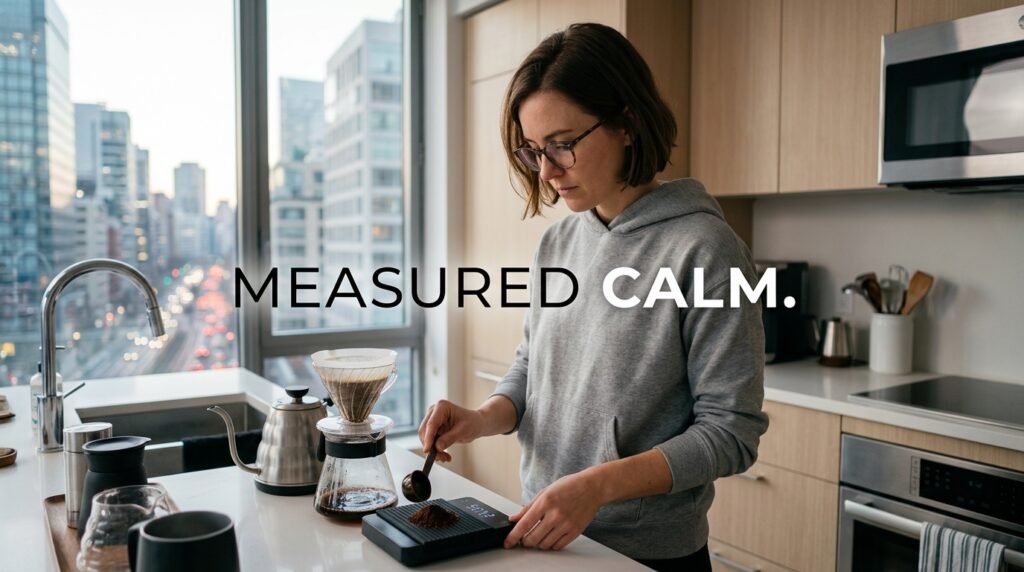
The scale provides a strict, reliable system. It tells my brain exactly what to do. I do not have to think. I do not have to guess. I simply look at the digital screen and follow the numbers.
Trust the Math
Take a critical look at how you prepare your morning beverage.
If you are currently reaching into a bag of expensive coffee with a plastic spoon, you are actively sabotaging your own extraction. You are guaranteeing a chaotic, unpredictable result in your cup. You are ignoring the basic laws of physics and chemistry.
Stop guessing. Buy a basic digital kitchen scale that measures in single grams.
Weigh your beans. Weigh your water. Do the simple multiplication. When you finally stop treating coffee brewing like a mysterious art and start treating it like strict mathematical data, the frustration completely vanishes. You will finally unlock the absolute clarity and the heavy sweetness that the roaster promised on the label. The math never lies.
