
I spend a large portion of my week building digital automations. I manage several websites and create workflows to handle repetitive data tasks. In the programming world, there is a very famous rule. It is called garbage in, garbage out.
If you feed bad data into a perfectly written script, the script will produce a broken result. The system is only as good as the raw material you put inside it.
On a quiet Friday morning in my home office, I realized I was completely ignoring this rule in my kitchen.
I was spending good money on premium, light roasted Ethiopian coffee beans. I was carefully measuring my water on a digital scale. I was using a beautiful glass pour over cone. I was doing everything right on the backend. But my coffee still tasted harsh, muddy, and wildly inconsistent.
The problem was my input device. I was using a terrible machine to break the beans apart. The coffee grinder that completely changed my brew was not an electronic gadget. It was a heavy, manual hand tool that forced me to respect the physics of extraction. It proved that the grinder is the absolute center of your coffee setup.
The Blade Grinder Disaster
For years, I used a cheap electric grinder I bought at a local appliance store. It was a small plastic cylinder with a spinning metal blade at the bottom.
I thought grinding coffee was just a matter of breaking the beans into smaller pieces. I thought the machine was doing its job. I was entirely wrong.
A blade grinder does not actually grind anything. It is just a miniature blender. It violently chops the beans in a chaotic, uncontrolled storm. The metal blade spins at thousands of revolutions per minute, smashing the hard seeds blindly.
You have absolutely zero control over the outcome. You push a button, wait ten seconds, and hope for the best.
The Problem of Inconsistent Particles
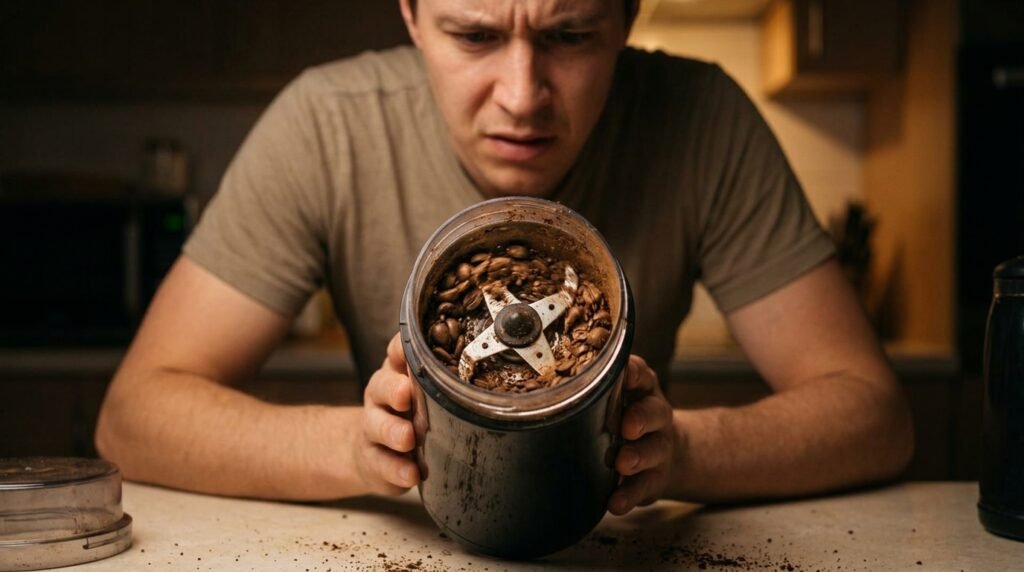
I opened the lid of my old electric grinder and looked closely at the coffee bed. The data I was feeding into my brewing system was an absolute disaster.
The coffee was a mix of two entirely different things.
Half of the beans were chopped into massive, chunky pieces. The industry calls these boulders. The other half of the beans were pulverized into a microscopic, powdery dust. The industry calls these fines.
This extreme inconsistency is an extraction nightmare. Hot water is a blind solvent. It extracts flavor based entirely on surface area.
The Chemistry of the Slurry
When I poured hot water over that chaotic mixture of boulders and dust, two terrible things happened simultaneously.
The massive boulders had very little exposed surface area. The water could not penetrate them. The water only washed the sour, sharp acids off the outside of the boulders and left the sweet sugars trapped inside. This created an aggressively sour flavor.
The microscopic dust had too much exposed surface area. The water instantly over extracted the fines. It pulled massive amounts of harsh, dry, bitter tannins into the liquid.
Experiencing this harsh, muddy flavor was exactly What I Discovered About Grinding Coffee Too Fine because the powdery dust completely ruined the entire batch. My mug was simultaneously sour and bitter. The bright peach and jasmine notes of my Ethiopian coffee were completely destroyed by the bad data.
Seeking the Hardware Upgrade
I knew I needed a massive hardware upgrade. I needed a tool that provided perfectly uniform data.
I started researching specialty coffee equipment. I quickly learned that the best grinders do not use spinning blades. They use burrs.
A burr grinder works exactly like a pepper mill. It uses two heavy metal gears. One gear is stationary. The other gear spins. The coffee beans fall between the two gears and are slowly crushed to a highly specific size. The distance between the two gears dictates the exact size of the final coffee particle.
I decided to skip the cheap electric models. Making this deliberate purchase was The Coffee Equipment Upgrade I’m Glad I Made because I wanted absolute precision. I ordered a premium manual hand grinder built entirely from stainless steel and aluminum.
The Tactile Weight
The new grinder arrived at my apartment in Rio de Janeiro a few days later. I pulled it out of the box.
The physical weight of the tool immediately shocked me. It was incredibly heavy. It felt like a piece of aerospace machinery. There were no cheap plastic parts. The central axle was supported by steel ball bearings. The ceramic burrs were aggressively sharp.
It felt like a precision scientific instrument. It did not belong in the same category as my old plastic blade blender.
At the bottom of the grinder, there was a metal dial with clearly defined clicks. This dial allowed me to adjust the distance between the burrs by a fraction of a millimeter. I finally had total control over my input data.
The First Mechanical Test
I wanted to see the visual difference immediately. I grabbed my bag of light roasted Ethiopian beans.
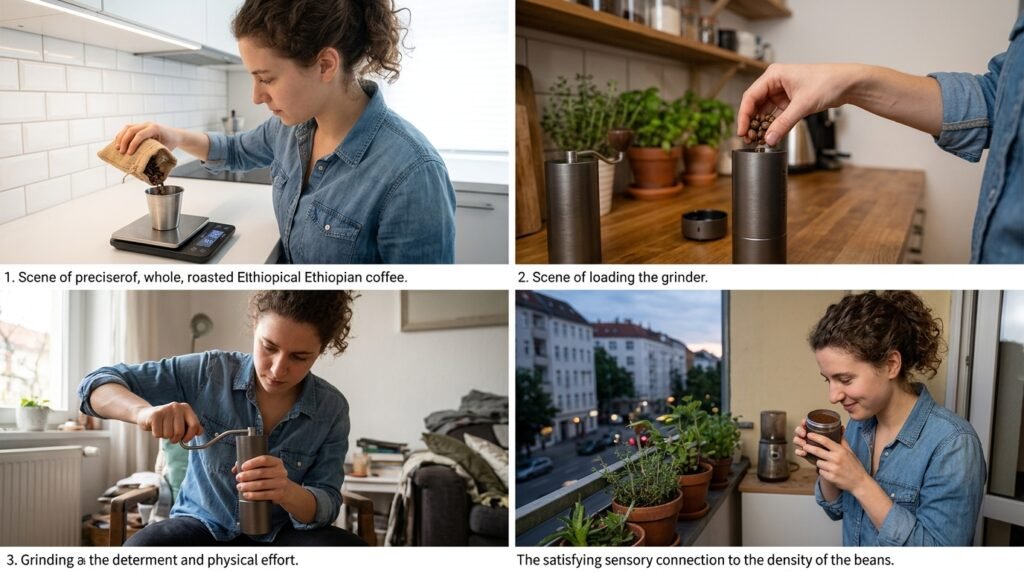
I set the metal dial to a medium fine setting. I weighed out exactly twenty grams of whole beans. I poured them into the top chamber of the heavy metal cylinder. I attached the handle.
I started turning the crank. The sensory experience was entirely new.
My old electric grinder screamed like a power tool. This manual grinder was nearly silent. I could only hear the satisfying crunch of the metal burrs slicing through the dense, high altitude seeds.
I also felt massive physical resistance. Because the grinder was actually cutting the beans instead of blindly smashing them, I had to use real effort. The mechanical feedback in my hands connected me directly to the physical density of the agricultural product.
Visualizing the Data
I finished grinding the twenty grams. I unscrewed the metal catch bin at the bottom.
I poured the dry coffee grounds onto a clean white ceramic plate. I spread them out evenly with my finger. I leaned in close and inspected the particles under the bright kitchen light.
The difference was absolutely staggering.
There were no massive boulders. There was no powdery dust. Every single piece of coffee looked exactly like the piece next to it. They looked like perfectly uniform grains of sea salt.
The precision of the metal burrs had produced a flawless data set. Grasping this visual perfection was the core lesson behind What I Learned After Switching to a Burr Grinder because I finally understood that uniformity equals clarity. The hot water would now treat every single particle exactly the same way.
The Brew Dynamics Change
I poured the uniform grounds into my glass V60 pour over cone. I boiled my gooseneck kettle.
I poured forty grams of hot water to initiate the bloom phase. The coffee bed reacted beautifully. Because there was no microscopic dust clogging the gaps between the particles, the water saturated the grounds instantly and evenly. The carbon dioxide gas escaped in a smooth, controlled dome.
I finished pouring the rest of the water. I watched the drawdown phase closely.
With my old blade grinder, the water always stalled. The powdery fines would sink to the bottom of the paper filter and create a thick, muddy barrier. The water would choke, extending the brew time to five or six minutes.
With the new burr grinder, the water flowed perfectly. The uniform particles created a highly permeable bed. The liquid drained steadily. The entire extraction finished exactly at the three minute mark. The spent coffee grounds at the bottom of the filter formed a perfectly flat, clean bed.
The Moment of Absolute Clarity
I removed the glass cone and tossed the filter in the trash. I carried my ceramic mug to the table.
I waited for the liquid to cool down. Extreme heat masks delicate flavors. I wanted my palate to experience the full spectrum of the extraction.
I took a slow sip. My brain completely stalled.
The flavor profile was entirely different. The harsh, aggressive bitterness was completely gone. The sour, sharp bite was entirely absent. The liquid felt incredibly clean and silky on my tongue.
Because every single particle extracted at the exact same rate, the flavor was focused and articulate. A massive, bright wave of sweet peach acidity hit my palate. That juicy note melted perfectly into a delicate, lingering flavor of jasmine flowers.
I could taste the Ethiopian soil. I could taste the high altitude. The hardware upgrade had successfully removed the static noise from the signal.
The Hidden Bottleneck
Sitting at my table, drinking that perfect cup, I realized how many people waste their money in the coffee world.
People constantly try to fix bad coffee by buying expensive espresso machines. They buy automated drip brewers with advanced thermal sensors. They buy expensive glass carafes.
They spend hundreds of dollars on the brewing device, but they continue using a cheap twenty dollar blade grinder.
This is like buying a high performance sports car and putting cheap, bald tires on it. The engine does not matter if the car cannot grip the road. The brewing device does not matter if the coffee grounds are a chaotic mess. The grinder is the ultimate bottleneck.
Investing in the Right Tool
Your grinder dictates the absolute flavor ceiling of your kitchen.
If you have a terrible grinder, you can buy the most expensive, highly rated coffee beans in the world, and they will still taste like bitter mud. The chaotic particle distribution will ruin the extraction every single time.
If you have a premium precision grinder, you can take a highly average bag of coffee and make it taste spectacular. The uniform extraction will highlight the natural sweetness and hide the flaws.
The grinder is the single most important piece of equipment you will ever own. It is the only tool that physically alters the raw ingredient.
The Daily Ritual Rebuilt
Upgrading to a manual hand grinder did more than just fix my flavor profile. It fixed my morning routine.
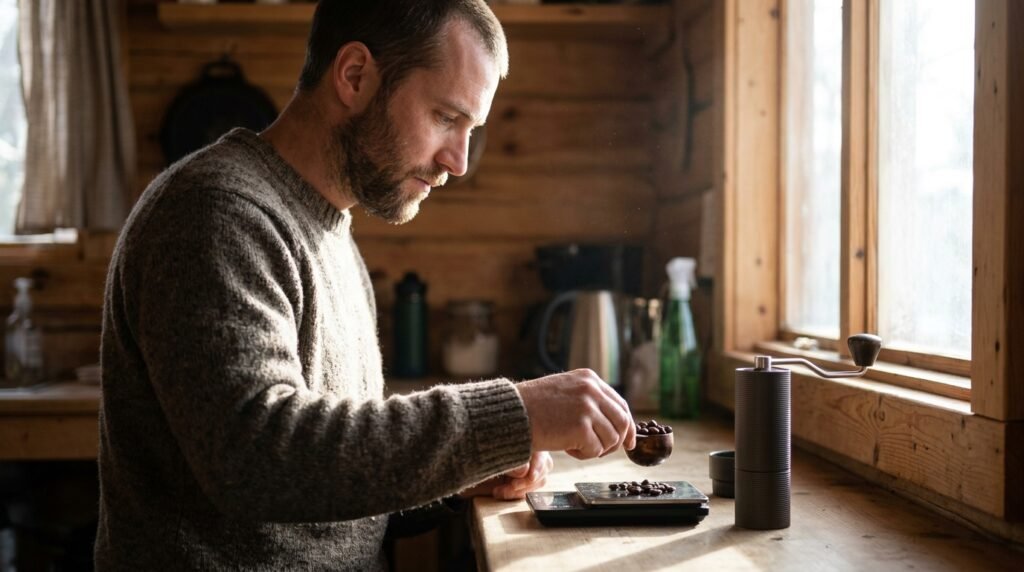
I no longer push a loud, screaming plastic button and wait passively. I have to physically participate in the process. I have to weigh my beans. I have to turn the dial to the exact micron setting I need for that specific roast profile. I have to stand in my kitchen and use my own physical energy to turn the heavy metal crank.
This tactile interaction forces me to slow down. It forces me to respect the agricultural product.
When I smell the massive burst of floral aroma escaping the metal catch bin, I know exactly what I am about to extract. I know the data is clean. I know the system will run perfectly.
Audit Your Own Kitchen
Take a critical look at your own coffee setup tomorrow morning.
Look at the machine you use to break your beans. Does it have a spinning metal blade? Do you push a single button? Look closely at the grounds before you brew them. Do you see large chunks mixed with a powdery dust?
If the answer is yes, you are currently ruining your coffee. You are hiding the true potential of the farm behind a wall of muddy extraction.
You do not need to buy a thousand dollar electric machine. You just need a high quality manual burr grinder. Invest in heavy steel and sharp ceramic. Invest in absolute particle uniformity. When you finally brew a perfectly uniform bed of coffee, the vibrant clarity of the flavor will completely change your standards. You will finally stop fighting the brewing process, and you will start tasting the actual bean.
