
I was sitting on my couch in Rio de Janeiro on a warm late April afternoon. I was testing a new digital note taking application on my smartphone. I constantly search for tools to organize my ideas quickly. I was completely absorbed in the digital interface.
My partner walked into the living room and dropped a small paper bag right onto my lap.
I put my phone down and picked up the bag. It was from a local specialty coffee roastery. I opened the top and looked inside. The beans looked entirely foreign to me. They were tiny, pale, and completely dry.
Up until that afternoon, I had a very strict, uncompromising definition of what good coffee should be. I thought my culinary preferences were permanently locked in place. I was absolutely wrong. The coffee bean experience that changed my preferences happened in my own kitchen ten minutes later. That single bag of pale seeds completely destroyed my old routine and forced me to relearn everything I knew about the beverage.
The Comfort of the Dark Routine
To understand the shock of this experience, you have to understand my old habits.
For years, I drank the exact same style of coffee. I preferred massive, dark roasted beans. I loved the heavy, oily texture. I wanted my morning mug to taste like dark cocoa powder, toasted peanuts, and burnt sugar. I wanted it to be thick and aggressively bold.
I drank that specific profile because it felt safe. It was deeply comforting. It required absolutely no intellectual effort to consume.
I built a massive culinary wall around myself. If a coffee did not taste like dark chocolate and heavy smoke, I refused to drink it. I assumed anything else was just sour, defective water. I was incredibly stubborn.

The Unfamiliar Label
I carried the new paper bag into the kitchen and set it on the counter. I looked at the label on the back.
It did not say “Dark Blend” or “French Roast.” It was incredibly specific. It said the coffee was from the Sidamo region of Ethiopia. It listed the botanical variety as a wild Heirloom mutation. It said the processing method was fully washed.
Discovering this specific farm was exactly How I Accidentally Bought the Best Coffee Beans I’ve Ever Tried because I never would have picked it off the shelf myself. My partner bought it simply because the bag looked interesting. We had absolutely no idea what we were about to extract.
The Visual Contradiction
I poured a handful of the Ethiopian beans onto a white ceramic plate.
They contradicted everything I thought I knew about the roasting process. My usual dark roasted beans were puffed up, swollen, and coated in a thick layer of slick, greasy oil. They left dark smudges on my fingers.
The Sidamo beans were entirely matte. There was zero oil visible anywhere. They were incredibly small and tightly packed. They looked like dry, pale peanuts.
I actually thought the roaster had made a mistake. I thought they had pulled the beans out of the oven too early and forgot to finish cooking them. I was highly skeptical. I almost poured them into the trash.
The Physical Struggle
I decided to brew them anyway. I grabbed my digital scale and weighed out twenty grams.
I poured the pale seeds into the hopper of my manual hand grinder. I attached the metal handle and started turning. My arm immediately hit a massive physical wall. The resistance was incredible.
My usual dark roasted beans were brittle. They shattered effortlessly in the grinder. These light roasted Ethiopian beans felt like solid gravel. The handle jerked violently in my hand. I had to grip the metal cylinder tightly against my chest and use genuine physical strength to force the ceramic burrs to spin.
This extreme physical struggle was my first real lesson in cellular density. The extreme high altitude of the Sidamo region forced the plant to grow very slowly, creating a rock hard seed. The roaster had stopped the heat early to preserve that exact structural integrity.
The Aromatic Awakening
I finally finished grinding the dense seeds. My arm was actually tired. I unscrewed the catch bin at the bottom of the grinder.
I brought the bin up to my nose and took a deep breath.
My brain completely stalled. The aroma was shocking. There was absolutely no smell of smoke. There was no smell of toasted wood or dark ash. The dry grounds smelled vibrantly sweet.
They smelled exactly like a basket of fresh peaches mixed with blooming jasmine flowers. The scent was delicate, complex, and incredibly perfume like. I stood in my kitchen and just inhaled the aroma for a full minute. I could not comprehend how a dry, hard seed could produce a smell that rivaled a botanical garden.
Dialing in the Chemistry
I knew my standard brewing recipe would fail. I usually brewed my dark roasts with cooler water to avoid pulling harsh, bitter tannins out of the brittle beans.
These Ethiopian beans were completely different. They were dense and hard. They would actively resist the extraction. If I used cool water, I would only wash the surface of the grounds. I needed maximum thermal energy to break into the cellular vault and dissolve those sweet peach sugars.
I turned my stove on and brought my gooseneck kettle to a violent, rolling boil.
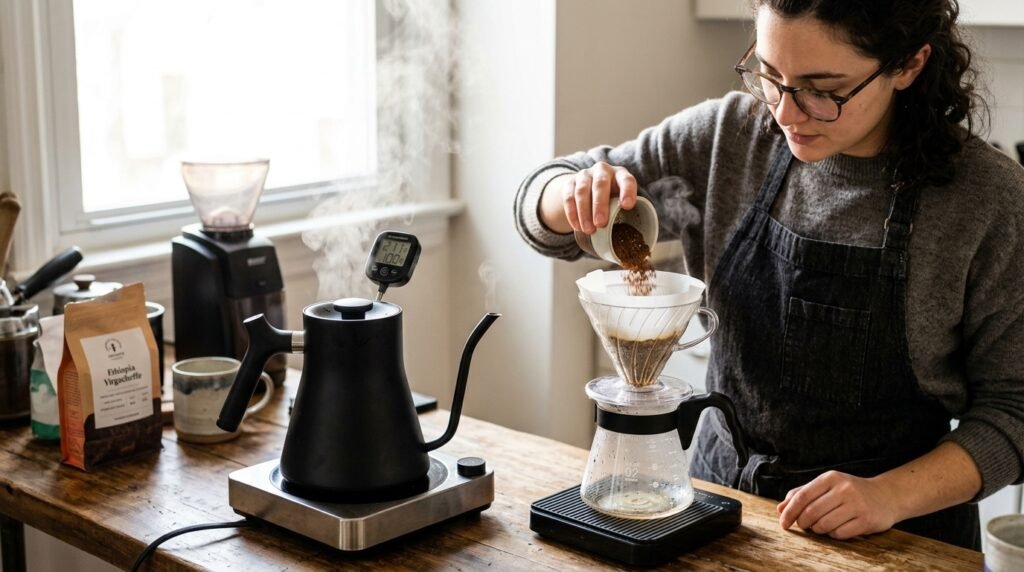
I set up my glass V60 pour over cone. I placed a paper filter inside and rinsed it heavily. I poured the fragrant, floral grounds into the damp paper.
The Calm Bloom
I poured forty grams of boiling water to start the bloom phase.
I expected a massive, violent eruption. Dark roasted coffees are filled with trapped carbon dioxide gas that aggressively bubbles and foams when hit with hot water.
The light roasted Sidamo reacted completely differently. The coffee bed expanded very slightly. A few gentle bubbles popped on the surface. The slurry looked calm, smooth, and heavy. Because the cellular structure was still tightly packed, the gas release was slow and controlled.
The steam rising from the glass cone carried the heavy scent of black tea directly into my face.
Managing the Flow Rate
I waited forty five seconds for the bloom to finish. I resumed pouring the boiling water.
I kept the stream of water incredibly thin. I poured in slow, tight concentric circles. I watched the liquid drain through the paper filter.
The liquid dripping into my ceramic mug was not black. It was a bright, translucent ruby red color. It looked more like a heavy fruit juice than a traditional cup of coffee. I watched the digital scale hit three hundred and twenty grams. I pulled the kettle away and let gravity finish the extraction.
The First Sip
I removed the glass cone and threw the paper filter in the trash. I carried the warm mug to my kitchen table.
I waited three minutes for the liquid to cool. Extreme heat masks delicate flavors. I wanted the coffee to be warm, not burning, so my palate could detect every single nuance.
I brought the mug to my lips and took a slow, deliberate sip.
The liquid felt incredibly crisp and light on my tongue. The heavy, oily blanket I was used to was completely absent. A massive wave of bright, sparkling lemon acidity hit the front of my palate. That sharp citrus note instantly melted into a heavy, syrupy sweetness that tasted exactly like ripe peaches.
As I swallowed, a clean, lingering note of jasmine flowers coated the back of my throat.
The Complete Overhaul
I sat at my table in absolute silence. The flavor was spectacular.
Experiencing this sharp contrast was the exact moment of The Coffee Bean I Tried That Blew Me Away and it ruined my old routine entirely. The complexity was staggering.
There was absolutely zero bitterness. There was zero ash. The liquid was vibrant and completely alive. It tasted like an expensive culinary ingredient, not a generic morning utility.
I took another sip. I realized I had been wrong for years. I had been drinking coffee in black and white. This single cup of Ethiopian Sidamo introduced me to color. I realized that my stubborn preference for dark roasts had blinded me to the actual potential of the agricultural product.
The Power of Genetics
I opened my laptop and started researching the label on the bag. I needed to understand how a brown seed could taste like a peach.
The answer was in the genetics. The label said Heirloom.
Unlike modern coffee farms in South America that plant perfectly organized rows of identical hybrid clones, Ethiopian farms harvest from wild, ancient forests. There are thousands of undocumented genetic mutations growing side by side. It is a massive, wild genetic soup.
You cannot replicate that genetic chaos anywhere else on earth. The bright peach and jasmine flavors are the direct, physical result of that ancient botany.
The Erasure of the Fire
I suddenly understood what roasting actually does to the bean.
The roaster who prepared my bag of Sidamo stopped the heat early. They did this specifically to protect those delicate heirloom genetics. They protected the peach. They protected the jasmine.
If they had left those beans in the hot drum for two more minutes, the intense fire would have completely incinerated those fragile fruit sugars. The bright acidity would have burned away. The coffee would have turned black, oily, and bitter.
I realized that dark roasting destroys the origin. It erases the genetics. It replaces the unique identity of the farm with the generic flavor of carbon.
Shifting the Geography
My buying habits changed instantly that afternoon. I threw away my old bags of dark roasted commercial blends.
I realized that if I wanted to taste fruit and flowers, I had to look at a global map. This geographical focus is precisely Why Single-Origin Coffee Changed the Way I Drink Coffee by forcing me to respect the farm over the factory.
I started hunting exclusively for light roasted, single origin coffees from East Africa. I looked for regions like Sidamo, Guji, and Yirgacheffe. I wanted to taste the high altitude volcanic soil. I wanted to taste the wild genetics.
I stopped buying anonymous blends entirely. I wanted my morning mug to have a distinct, undeniable identity.
The Difficulty of Change
Changing a deeply ingrained culinary preference is incredibly difficult. We build strong emotional attachments to the foods and drinks we consume every day.
When you drink the exact same heavy, chocolatey coffee for ten years, your brain maps that flavor as the ultimate standard. When you suddenly introduce a bright, acidic, fruity coffee to your palate, your brain initially rejects it. It feels wrong. It feels confusing.
You have to push past that initial confusion. You have to give your palate time to adjust.
Once your tongue learns how to identify the natural fruit sugars, and once your nose learns how to isolate the delicate floral aromas, you can never go back. The heavy, dark roasts suddenly taste flat, boring, and aggressively burnt.
The Pursuit of Clarity
My entire coffee routine is now based on clarity.
I use a precision hand grinder to ensure my particles are perfectly uniform. I use a digital scale to measure my water to the exact gram. I use violently boiling water to extract the dense, light roasted seeds.
I do not do this to be pretentious. I do this because the raw ingredient demands respect.
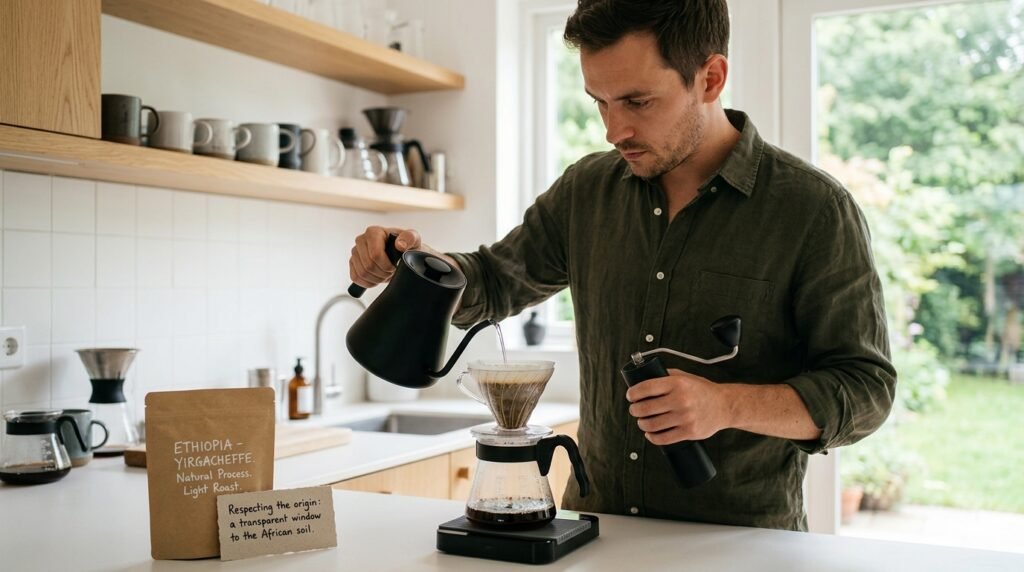
An Ethiopian farmer spent months cultivating a wild tree on a steep volcanic mountain. A skilled roaster perfectly developed the sugars in a hot metal drum. If I brew the coffee sloppily, I ruin their hard work. I want the final cup to be a perfect, transparent window directly to the African soil.
Challenge Your Own Palate
If you are currently stuck in a comfortable culinary bubble, you are missing out on an incredible global adventure.
If you drink the exact same dark, heavy coffee every single morning, you are robbing yourself of the true potential of the beverage. You are drinking the flavor of a roasting oven, not the flavor of a farm.
I challenge you to break your own rules this week. Go to a local independent roastery. Ask the barista to give you their brightest, most acidic light roast. Look for a washed coffee from Ethiopia or Kenya.
Take it home. Look at the pale beans. Feel the dense resistance in your grinder. Brew it carefully with boiling water.
When you take that first sip, do not immediately reject the bright fruit acidity. Let it coat your tongue. Look for the peach. Look for the lemon. Look for the jasmine. When you finally allow your preferences to change, your morning routine stops being a mindless chore. It becomes a brilliant, dynamic sensory exploration.
