
I live in Rio de Janeiro. Coffee is a fundamental part of the culture here. You can smell roasted coffee walking past almost every bakery in the city. But the local commercial coffee is usually roasted incredibly dark and served with massive amounts of sugar.
I spend my entire week staring at a computer screen. I manage digital content, optimize websites, and build automated workflows. By Saturday afternoon, my brain is completely exhausted from the digital noise. I need a physical, analog distraction.
On a recent Saturday, I could hear a Vasco da Gama football match playing on a neighbor’s radio down the street. I decided to ignore my laptop and conduct a massive sensory experiment in my kitchen.
I had two bags of specialty coffee on my counter. One bag was grown locally here in Brazil. The other bag was imported from the Guji zone of Ethiopia. I decided to brew them at the exact same time. What I learned from trying coffee beans from Brazil and Ethiopia completely changed my understanding of global agriculture. It proved that geography is an undeniable physical force.
Setting Up the Contrast
I wanted to create a perfectly level playing field. I cleared my kitchen counter.
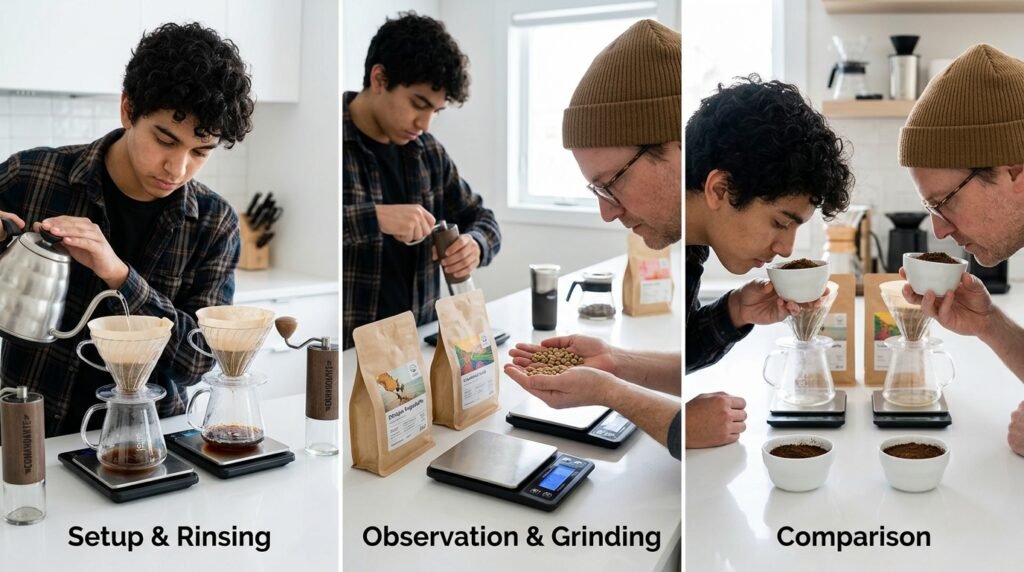
I pulled out two identical glass V60 pour over cones. I placed two identical paper filters inside them. I rinsed both filters with hot water. I set up my precision digital scale and my manual hand grinder.
Running this dual experiment was exactly The Day I Compared Two Different Coffee Beans Side by Side because I needed to isolate the variables. Both coffees were light roasted. Both coffees were fresh. The only changing variable was the dirt they grew in.
I opened the bags. I wanted to observe every single physical difference before I ever turned on my kettle.
The Geography of Brazil
I poured a handful of the Brazilian beans onto a white ceramic plate.
Brazil is the largest coffee producer on the planet. The geography of the country dictates the physical nature of the plant. Most Brazilian coffee farms are located on massive, sweeping plains in regions like Minas Gerais.
The altitude is relatively low compared to other specialty coffee countries. The climate is warm, stable, and highly predictable.
Because the environment is so stable, the coffee cherries mature quickly. The farmers usually plant highly engineered hybrid clones like Yellow Bourbon or Mundo Novo. These hybrid plants are designed to be perfectly consistent.
I looked at the Brazilian beans on my plate. They reflected that consistency perfectly. They were large, round, and incredibly uniform. Every single bean looked exactly like the bean next to it. They looked like a highly organized agricultural product.
The Wild Landscape of Ethiopia
I poured a handful of the Ethiopian beans onto the other side of the white plate. The visual contrast was absolutely staggering.
Ethiopia is the ancient biological birthplace of the Arabica coffee plant. The landscape is completely different from the flat plains of Brazil. The Guji zone features extreme, steep volcanic mountains. The altitude is massive. The days are hot, but the nights are freezing cold.
Ethiopian farmers do not plant organized rows of identical hybrid clones. They harvest wild plants directly from the ancient forests. Botanists call this a genetic soup of Heirloom or Landrace varieties.
I looked at the Ethiopian beans on my plate. They looked completely wild. They were tiny, jagged, and entirely inconsistent. Some were long. Some were perfectly round like small peas. They looked like seeds pulled randomly from a deep jungle.
The Density Test
I needed to grind twenty grams of each coffee. I started with the Brazilian beans.
I poured them into my manual hand grinder and turned the metal crank. The ceramic burrs sliced through the beans easily. The physical resistance was very low.
Because Brazilian coffee grows at lower altitudes in warmer climates, the cellular structure of the seed is relatively soft. The plant does not have to fight to survive.
I wiped the grinder clean and poured twenty grams of the Ethiopian beans into the hopper. I grabbed the handle. The physical resistance was massive. The handle violently jerked in my hand. I had to use real physical strength to crush the seeds.
The extreme high altitude and freezing nights of the Ethiopian mountains force the plant into survival mode. The cherry matures incredibly slowly. This creates an incredibly hard, dense cellular structure. You can literally feel the tough mountain environment in your own hands.
The Aromatic Divide
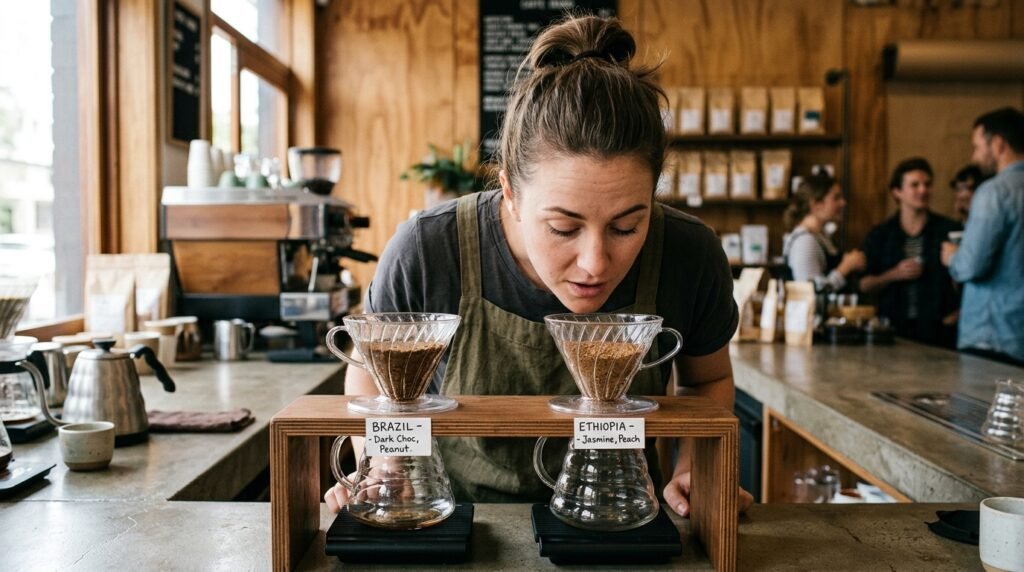
I placed the ground Brazilian coffee into the first glass cone. I placed the ground Ethiopian coffee into the second glass cone.
I leaned over the counter and smelled the dry Brazilian grounds. The aroma was deeply comforting. It smelled exactly like a bakery. The dominant notes were dark chocolate, toasted peanuts, and heavy brown sugar. It was a round, sweet, and highly predictable scent.
I moved my face over the Ethiopian grounds and took a deep breath.
The aroma completely shocked my senses. There was no chocolate. There were no peanuts. The dry grounds smelled intensely of sweet spring flowers and bright citrus. The dominant notes were jasmine, ripe peach, and black tea. It smelled vibrant, sharp, and totally wild.
Adjusting the Chemistry
I reached for my gooseneck kettle. I knew I could not use the exact same water temperature for both glass cones.
The physical density of the seed dictates the thermal energy required for extraction.
The softer Brazilian beans would surrender their flavors easily. If I used violently boiling water, I would over extract the grounds and pull out harsh, bitter tannins. I let my kettle cool down to one hundred and ninety degrees Fahrenheit.
The rock hard Ethiopian beans demanded the opposite approach. The dense cellular walls actively resist water. If I used cooler water, I would only wash the sharp acids off the surface. I turned the stove back on and brought the kettle to a rolling boil. I needed maximum heat to break into the African seeds.
The Dual Extraction
I poured forty grams of hot water into the Brazilian cone. The coffee bed expanded smoothly. A heavy, sweet smell of caramel filled the air.
I poured forty grams of boiling water into the Ethiopian cone. The reaction was entirely different. The dense grounds swelled aggressively. The intense heat forced the trapped gas to violently escape, carrying a massive wave of floral jasmine steam directly into my face.
I finished pouring the water into both cones. I poured in slow, concentric circles.
I watched the drawdown phase. The Brazilian coffee drained quickly. The liquid dripping into the mug was a dark, heavy brown color. The Ethiopian coffee drained much slower due to the dense, jagged particles. The liquid dripping into that mug was a bright, translucent ruby red.
Tasting the Comfort of Brazil
I removed the glass cones and tossed the filters in the trash. I carried both ceramic mugs to my kitchen table.
I grabbed a glass of cold water to cleanse my palate. I picked up the mug containing the Brazilian coffee.
I took a slow sip. The flavor was incredibly heavy and rich. The liquid coated my tongue like a thick syrup. The chocolate and peanut notes I smelled earlier translated perfectly into the flavor. It was a very low acidity coffee. It tasted sweet, grounded, and deeply comforting.
It was the kind of coffee you want to drink on a rainy morning. It was not challenging. It was familiar and safe.
Tasting the Vibrancy of Ethiopia
I drank a large gulp of cold water. I waited a full minute. I picked up the mug containing the Ethiopian coffee.
I took a sip. My brain immediately scrambled to process the contrast.
The heavy, oily blanket was completely gone. The liquid felt crisp and light on my tongue. Instead of dark chocolate, a massive wave of bright, juicy acidity washed over my palate. It tasted exactly like biting into a ripe, sweet peach.
The floral notes lingered in the back of my throat long after I swallowed. The coffee was complex, vibrant, and highly articulate. It demanded my full attention. It did not taste like a morning utility beverage. It tasted like an expensive culinary ingredient.
The Power of Terroir
Sitting at my table and switching between the two mugs taught me a profound lesson.
You cannot force a coffee bean to be something it is not. A skilled roaster can highlight certain flavors, but the core identity of the bean is decided entirely by the dirt.
The flat terrain, lower altitude, and hybrid genetics of Brazil will always produce a heavy, comforting, chocolatey cup. The volcanic mountains, freezing nights, and wild genetics of Ethiopia will always produce a bright, floral, highly acidic cup.
This concept is heavily utilized in the wine industry. Grasping this agricultural science is exactly How I Learned Coffee Profiles Are Like Wine Notes and permanently changed how I evaluate my coffee. The environment physically rewrites the chemistry of the fruit. The geography is the flavor.
Escaping the Commercial Blend
This dual tasting completely validated my decision to stop buying commercial coffee blends from the supermarket.
Massive coffee corporations buy cheap beans from Brazil and mix them with cheap beans from Africa. They do this to create a completely generic, middle of the road flavor profile.
If you mix the heavy chocolate of Brazil with the delicate jasmine of Ethiopia, they cancel each other out. The heavy body smothers the delicate florals. The sharp acidity ruins the smooth chocolate. You create a muddy, confused beverage.
Embracing the unblended, pure identity of the farm is precisely Why Single-Origin Coffee Changed the Way I Drink Coffee and elevated my daily routine. I want to taste the specific country. I do not want a chaotic global mixture.
The Importance of Variety
I finished both mugs of coffee while the Vasco game ended down the street. I realized that neither coffee was objectively better than the other. They simply serve entirely different purposes.
Sometimes my brain is exhausted from building digital automations, and I just want a heavy, comforting cup of Brazilian chocolate. I want a coffee that feels like a warm blanket.
Sometimes I wake up feeling energized, and I want a coffee that challenges my palate. I want the bright, floral explosion of an Ethiopian Guji. I want an intellectual sensory experience.
Having access to both ends of the global spectrum is the true luxury of specialty coffee.

Build Your Own Map
You do not need an expensive coffee laboratory to experience this global contrast. You already have a kitchen counter and a ceramic mug.
I highly encourage you to build your own geographical map this weekend.
Go to an independent specialty coffee roaster in your city. Buy a bag of single origin coffee from South America. Look for Brazil or Colombia. Then, buy a bag of single origin coffee from East Africa. Look for Ethiopia or Kenya.
Bring them home. Look at the physical differences on a white plate. Feel the massive difference in density when you turn the handle of your grinder. Brew them side by side using the exact same equipment.
When you taste the heavy chocolate and the bright peach back to back, the abstract concept of global agriculture becomes a physical reality on your tongue. You will finally understand that the dirt dictates everything, and your morning routine will become an incredible culinary adventure.
